TEDxNewy Salon 1

Newcastle 2050: What if?

Citizen conversations on the future of the city — captured at the salon, transcribed, themed, and held lightly. This page is a living workspace; more sources (paper notes, post-its, photographs) will be added under each topic as they are processed.

3topics
7audio captures
~104minutes recorded
~15,000spoken words
297post-it notes
30 Apr – 1 May 2026captured
🚲 Topic prompt How will we move through, in and out of Newcastle in 2050?
2recordings
~37minutes
~4,500words
117post-it notes

Key themes

E-bikes are here, the infrastructure isn't

The conversation accepts e-bikes as inevitable — but flags real safety tension on Honeysuckle and Hunter St where they "compete with pedestrians and cars". Calls for separated lanes, learner schemes, and a mindset shift: "we should be e-bike city".

Strong consensus

High-speed rail will reshape Newcastle — for better or worse

Excitement about an HSR link to Sydney, paired with anxiety: it will lift population and tourism but, "if it's not actively managed, it will decrease housing affordability 100%". Group lands on "thoughtfully planned for".

Hopes & risks

Airport: international connectivity = the tipping point

A direct international flight (NZ, Asia) is seen as the unlock for tourism and demand-led transport upgrades. The cheap $3.50 bus to the airport gets a shout-out, but most still drive and park.

Catalyst

Tram is loved, but doesn't go anywhere

"The tram just takes you from the train station to the beach." Affection for the asset; frustration at its limited reach. Implicit ask: extend the network so more people can actually use it.

Asset under-used

Bus network has gaps — and safety issues at night

Buses praised for affordability where they exist, but "messy and unsafe" elsewhere, with stories of people being approached or chased on routes through Mayfield, Junction, Union St. A clear gendered dimension to who feels safe.

Equity

Car dependence is the default — and expensive

"I don't go anywhere longer than 10 minutes." $12/day to park in the CBD. Most participants drove to the venue. The car is winning by convenience even where alternatives exist.

Status quo

Connective tissue between precincts

Fond memory of the Newcastle tuk-tuks ("the coffee guy started them") as a missing connector. Lime bikes flopped in days. The pattern: Newcastle has destinations but few ways to thread them together at human pace.

Pattern

Walkability is underrated

Newcastle is "quite flat, which makes it quite a walkable city" — and feels safe at night for those who do walk centrally. Untapped potential if mode is supported and lit.

Hidden strength

Autonomous and shared futures

Waymo-style autonomous taxis come up as a 2050 baseline assumption. Less a vision, more a "it'll be here, what do we do with it?" — particularly for a small, contained CBD.

2050 baseline

Visualisations

How often each mode came up

Actual mention counts in the two Transport session transcripts (case-insensitive keyword match, includes related terms like drive / parking for car, cycle / bike for cycling).

Car / driving / parking35
Cycling (any kind)30
Airport / planes / flights17
Walking15
E-bikes (specifically)14
Bus9
Tram / light rail6
Train / heavy rail (incl. HSR)5
Autonomous (Waymo)2
Tuk-tuks / Lime bikes0*

* Tuk-tuks and Lime bikes were named with affection in the Night Culture sessions as missed connectors, not in these Transport recordings — surfaced under "what's gone".

👍 Loved / wanted more of

  • Walking "Quite a flat, walkable city" — Wickham → CBD on foot at night feels safe
  • Tram "I love the tram" — universally affectionate, but limited reach
  • Airport expansion Direct international (NZ, Asia) framed as the unlock
  • $3.50 airport bus "Half an hour. It's amazing." A small standout.
  • Separated bike lanes Amsterdam, France, NYC offered as the model

⚖️ Mixed / contested

  • E-bikes Inevitable, beloved by kids — but conflict on Honeysuckle, school logistics, rules unclear
  • High-speed rail Excitement vs. fear of becoming a Sydney dormitory; affordability flag
  • Autonomous vehicles "It'd scare the hell out of me — but it's coming" (2050 baseline)
  • Population growth Welcome if planned — disastrous if not

⚠️ Friction / barrier

  • Car dependence "I don't go anywhere longer than 10 minutes"; $12/day to park
  • Bus safety after dark Mayfield/Junction routes; women approached, riders chased
  • Cycle infrastructure absence "E-bikes competing with pedestrians and cars"
  • Lime bikes (failed pilot) "They dropped about 20 off and never came back"
  • Tuk-tuks (gone) Fondly remembered, no current equivalent

Voices

The trains don't take you anywhere besides Sydney. The buses are messy and unsafe. The tram just takes you from the train station to the beach. — participant, Transport session
We should be e-bike city. We've got the perfect climate. — participant, Transport session
Right now the e-bike's competing with pedestrians and cars. They need to be their own thing. — participant, Transport session
I can catch the bus at $3.50 from the interchange to the airport. Half an hour. It's amazing. — participant, Transport session
If high-speed rail isn't actively managed, it will decrease housing affordability 100%. — participant, Transport session
We've got 35 kids on e-bikes now, parking their e-bikes at school. — teacher, Transport session
It went through the uni and then down to Mayfield… at late night, it was quite unsafe. My little sister used to get approached by old men all the time on the bus. — participant, Transport session
The tuk-tuks were so cool — it was such a good way to connect people to the places. — participant, Night Culture session (recalled)

Raw transcripts

Methodology note. Transcribed locally with whisper.cpp (large-v3-turbo, English). No diarisation or speaker labels. Whisper occasionally loops on quiet audio — Transport ZOOM0006 in particular has a long "I don't want to be pessimistic" repeat that is a transcription artifact, not real speech. Themes above are based on the substantive content only.
Transport — ZOOM0005 ~18 min · 3,415 words
So you're from the airport you said? Yeah, the marketing comes at the airport so right into a lot of these topics here. So what are your big priorities and issues and things? More international connectivity and if that does happen it will obviously bring a lot of tourism to the region. We also give us more options as people working in this year and remember to get more people going to the airport than just before this region. It's near one from Glasgow to Port Pro so that's actually a lot of people coming to Newcastle so I think that's an awesome thing to develop. And it will happen. Yeah, that's definitely going to come up for sure. The expansion at the moment is already incredible. Yeah. Have you guys used the airport? Yep. Use it more when they can get me home to NZ faster. We're working on it. I don't know. We're working on it. Tomorrow, come on. The Kiwi Express. Exactly. We're going to drive to Sydney, catch on a flight. I had a few minutes in Hobart. So I love the fact that the Hobart flight was there. So I was able to go to his graduation last week and I took the last flight down. I couldn't get a direct flight back though. So it's only a seasonal thing. Yeah, okay. We were saying the same thing. Our youngest son lives in Hobart and that direct flight is such a difference. Yeah. So four or five hours. Yeah, yeah. Makes it just like, yeah. What's happening with transport to get to the airport though? That's my question. Yeah, that's very important. How do you guys get there? Yeah, usually drive and park there. Like the parking facility is really good and at a pretty reasonable price, which is great. However, I just feel sometimes like, you know, it's, if you're staying for, if you're going overseas for a long term, it's probably not really ideal. So usually I just get dad to drop me off. But if there was a way, like when I lived in Sydney, they had shuttle buses all the time that would drive around and pick you up and that was really good. So something like that. Are there airport buses at the moment? I don't know. Are there? I live near the interchange. I was saying this before. I can catch the bus at $3.50 from the interchange to the airport. Oh, there we go. Cost you $4.50. Half an hour. It's amazing. But I'm just fortunate to be in a place where I can just jump on the bus and I'm there. It would be harder depending where you live in Newcastle. Yeah. It's the biggest challenge. You look at all the ways to get to the airport on a place. It's like some of our big tourism destinations. Yeah. Of course, they're going to stay for us. But kind of value is harder. I was looking at it the other day, people from the cluster, for instance, when I get to the airport, it takes hours and hours and hours. Yeah. But that's the big challenge, is it's not enough people to notice. It makes sense. Yeah. We're not far off. Yeah. Give it a couple more years, it would be a necessity for a number of people to speak. But I think from an airport point of view, the more noise people make, the more times a day, if you want to see your local member, you know, shove it on Facebook. Yeah. Yeah. There you go. Yeah. So important. So that's what comes first. What comes first is the surfing through the airport and then that results in the transport. Once they have international tours, like Keelees and probably Singaporeans and all of Asia as well, you'll find people will come in and they'll be like, how do I get to the rest of that time? Yeah. Yeah. That's a lot of push them up. Yeah. I'd say the bay and some of those are all we say. Interesting. No, not at all. That's so important though. All right. So what should transport and mobility in Newcastle in 2050 look like? Which modes of transport do you have to do? Yeah. So, I mean, I think there's the elephant question in the room right now. How much do we drive and how much should we drive? 2050 there's going to be drive on this car, as you put it here first. But again, if you think about it, even just the city how it is now, right, it's a very small city, like you can easily get around. Yeah. Like why not have it in a space of like what they have in certain states and like America, for example, where literally in this one area, it's just you hop in a car and it takes you where you fit. The Waymo's, is that the? The Waymo's, yeah. Yeah, yeah, yeah. Yeah, really. I've never been in one, but apparently it's like, it would scare the hell out of me, don't be wrong. But like, in 2050, I'm guaranteed that there's something that happened in there. Yeah. What about the tram? The tram? I love the tram. Really? I think it's great. Yeah. I do too. I'd love to see the tram. It's got to go somewhere. That's the thing. It's just, it's just, it's too small. It's just that. Yeah. Where would you like it? I don't need, for me, I don't need to go any further than it is, but I just know that there are not enough people get to use that sort of facility in this city. Yeah. And then when they built it, everyone's like, this is cool. Yeah. And then when they built it, everyone's like, this is cool. Yeah. It's cool. It's cool. It's cool. It's cool. It's cool. It's cool. It's cool. It's cool. It's cool. It's cool. You can do a lot of development out there. It's cool. It's cool. Yeah. I was saying that I've come from the Gold Coast. The tram on the Gold Coast now that goes from Rubina all the way through to Liverpool University, all the way up to Helmshaw. A lot of protests when it was going in because of the disruption it caused to businesses when streets were closing down for one or two years. But now it's a godsend, I think. And clean. What about e-bikes? They're here to stay now, aren't they? Do you think? For sure. I'm not that responsible for myself. Do you think they'll be like, am I worried about them? Yeah. I feel like I'm going to be coming down and the person's like, are they going so far? Yeah, yeah, yeah. And they just, I don't know. But we don't cater for them. We have them up and down honeysuckle where you're trying to walk along the waterfront there and speed back some childhood cars. Or on the streets where they just dance. What do we do? Yeah. I don't know. I don't know. It's here to stay but you've got to have some rules around it as well. Yeah. Like if, like... The bike lanes are going to be like having like proper dedicated bike lanes. Yeah. We have to improve that. If you can't drive a car, you can't drive anywhere. Alright. And we... It's like you can have like a learner's plate or something like how to be on the road with the person. Or just a three strike system. Three strikes you're out? Or a license. Yeah. Yeah. Not really. But at the same time, yeah, I was just saying before, I feel like you get really grilled for things. Like, first of all, everyone was complaining that they're always at home on their phone and they're not doing anything. And now they're outside doing something and people aren't happy. But I just feel like, I just, yeah, I just feel like we just need to give them options. Like, you can't just keep pointing the finger at them and saying it's all your fault. That's cool. Like, we need to give them an option. And if you're a 14 year old kid and you see one of those e-bikes, you want to be on it. Yeah. Don't you? Like, really? That's such a buzz. It's cool. I'm 30 and I want to be on one of those. My 14, that's one of me. I want to buy one of them. And I think this is not just kids on those bikes. No. No. They're really, really widely popular. So I think, I think you're right. I think they've never stayed. Yeah. The question is where are they going to stay? Yeah. Just. And are they, are we doing enough to keep the same? I don't know. How many of us? New York does it though. Yeah. I mean, lots of white lanes and they have. I think there was a bank in New York that set up the original, like, the rent-a-bite system. And now they're all electric. And it's like, they just set up the infrastructure for it, with some rules. And speed being on that. Yeah. Well in fact, it might not even mean that you need to do anything about speed. I mean, I was thinking about Amsterdam. Because they've got the, um, car lanes and then on each side of the road, there's like the signal against the bike lanes. Yeah. So, and it's really, it's really, it's just running bikes. Yeah. So you wouldn't need to be too worried about speed. They don't even wear bike covers because it's like, there's a mass of people just riding bikes all the time. Yeah. So, the more people you've got riding, the safer it needs to ride. Yeah. So. It's like, in running a motorbike in Vietnam, you'd imagine it's like, your worst nightmare, but it's actually even easier. Because they're getting out for everyone and then, like, we've been out and everyone's very, like, no road rage. Everyone's like, yeah, that's the road rage. Yeah. That's the road rage. Yeah. Yeah. Yeah. Please, cut in. Yeah. Yeah. Yeah. So, yeah. I love that one. What's, um, what I'm really interested in is what, um, the increasing population is getting to the public transport week, you know, the next door bus driver, and he talks about that and goes, you know, all the buses are really packed, or, you know, there's not so many new buses, but they're packed with the fuel prices way more than the bus. It's like, it's getting terrible. Yeah. Yeah. How does that change the bus? Do you think it would only increase the ability to have those transports? Yeah. Are you going to start doing it now, right? Yeah. Yeah. Do you think it would only increase the ability to have those transports? Yeah. Are you going to start doing it now, right? Yeah. Are you going to start doing it now, right? Yeah. Are you going to start doing it now, right? Yeah. Are you going to start doing it now, right? Yeah. Do you think it would only increase the ability to have those transports? Yeah. Are you going to start doing it now, right? Are you going to start doing it now, right? Are you going to start doing it now, right? Are you going to do it when it happens? Yeah. That's a great point. Before that. Once that happens, this place is going to be... Yeah. Yeah. What's the hot-speed reality? When are they saying that it's going to estimate? I think it'll be academic for me. I think it's 2042. Yeah. I think that date changes as well. Yeah. Have you done real? For 30 years. I was going to say, I remember these conversations last few years. Oh, really? Okay. Yeah. Yeah. Oh, my God. Okay. Yeah. Okay. We're going to see. Come join us. Yeah. We're going to see. Come join us. Yeah, jump in. I just crashed. Sorry. I know. Have a good seat. Are you sure? Yeah, absolutely. You guys are, you're on it. We're on it. We're on it. We're on it. We're on it. We're on it. We're on it. We're on it. We're on it. We're on it. We're on it. We're on it. We're on it. We're on it. We're on it. We're on it. We're on it. We're on it. We're on it. We're on it. We're on it. We're on it. We're on it. We're on it. So do you all drive a lot? Yeah. Yeah. Yeah. I'll be pretty honest with you. I mean, I've been in Newcastle two and a half, half years. I've only caught the transport down in Sydney. Otherwise, I'm driving. Yeah. Okay. I don't know what it is. I think it's just the convenience of just being able to go place to place to place to place to place to place. Same. And plus, I got into the habit of like just going nowhere longer than like 10 minutes. Yeah. I don't care for longer than 10 minutes now. I'm stuck. Yeah. Yeah. Yeah. The trains don't take you anywhere besides Sydney. And then the buses are always like messy and unsafe. Yeah. Yeah. Yeah. And the tram just takes you from the train station to the beach. Yeah. Yeah. Where do you live? I live, I live now in Newcastle. But I used to live in Birmingham. Oh, right. But you work here obviously. Yeah. I work here obviously. Yeah. I work here obviously. Yeah. I work here in town. and like a bus from there in town is like 45 minutes. And it drove through like, I used to, yeah. It went through the uni and then down. Um, to St. Louis and St. Louis and St. Louis. Yeah. And it was, yeah. And it was, yeah. It was, yeah. It was like, that's the uni and then down. Um, to St. Louis and St. Louis and St. Louis. And then it was like, that's the uni and then down. Um, to St. Louis and St. Louis. And then it was like, that's the uni. And then it was like, that's the uni. And then it was like, that's the uni. And then it was like, that's the uni. And then it was like, that's the uni. And then it was like, that's the uni. And then it was like, that's the uni. And then it was like, that's the uni. And then it was like, that's the uni. And then it was like, that's the uni. And then it was like, that's the uni. And then it was like, that's the uni. I used to, yeah. I used to, yeah. I used to, yeah. It went through, um, the uni. And then down, um, to St. Louis. Boratah. And then through Mayfield. Um, so it was like, at late night, it was quite unsafe. You had to get with us, um, to get home as well. It was probably quite cool. Yeah, that's like, you could probably get stuck in the uni. But, they're only in gardens. It's like, it feels like the middle of nowhere. Yeah. It's only at the back of Mayfield. Where is it? Yeah. It's not far, but it's like, it's hard to get there. And like, like, my little sister used to get approached by, like, old men all the time on the bus. That's good. Yeah. That's terrible. And even like, I live in, yeah, in, in, in Wickham now. And I drive to work, like, because it's just like, like... You drive to work? Where do you park? Uh, yeah. Well, I, like, yeah. Yeah, yeah. Pretty much wherever I can. Okay. But, yeah. Is this the e-bike coming? Yeah, yeah. Yeah. Yeah. I have a bike, but then even like, sometimes riding, riding home down Huntington is like, pretty unsafe at night. Yeah. Like, I've had like, like, people, can you say me? No. Really? Just a normal push bike or an e-bike? Yeah, yeah. Just a normal push bike. Yeah. Yeah. And like, some of my friends who live in, um, he lives in the Junction, he's been like, followed down the street and chased, uh, on Union Street. Yeah. Um, a bunch of times. Yeah. Yeah, that's not ideal. Yeah. Yeah, that's not ideal. Yeah. And it's not, it's, it's not, it's not much better off. I live at Wickham and I walk to work. Yeah. Yeah. Because it's, it's a beautiful walk, you don't know, so by the time you get to, walking home is even better. Yeah. And it costs 12 bucks a day to park here. Yeah. It's crazy. You're paying $60 a week if you drive, just to park. Yeah. Um, e-bike. E-bike. You don't have to go. Parking three. You don't work at an e-bike, please. No, I do not. Newcastle. I encourage people to drive or at least to walk or something like that. We've got 35, I work at the school up here. Yeah. We've got 35 kids on e-bikes now, parking their e-bikes at school. Oh, wow. It's just madness. You've got to build new infrastructure. Yeah, yeah, yeah. We've got to build a parking board. Second level of e-bike parking. Yeah. And getting them out, getting them safely onto the street in the afternoon at 2 o'clock. Oh, wow. It's actually a lot less than you think, given how many students are at grammar? About, well, on the hill, they're about 900. Yeah. Yeah, it said to have 25 bikes or whatever. It's just been here. Yeah. They all live local. Yeah. Those kids rule Bar Beach, that sort of area. That makes sense. It saves mum and dad from driving to work. Yeah. Yeah. I think, well, yeah. I mean, apart from the safety, that's actually a really good solution. Yeah. It is. If we, yeah, if we can do something about that to make them a little more safe. Maybe some, I don't know, some training or something that you have to, yeah. I don't know. But. Yeah. Well, I'd love to see, you know, talking about Vietnam. We were talking about Vietnam and all the students are buying some Vietnam. Yeah. We can do that here. Yeah. I mean, we should be e-bike city in this place. Right. We've got the perfect climate. I agree. Yeah. It's a beautiful environment here. Yeah. Yeah. It just needs to be safe. Yeah. Yeah. For sure. And it would be great if we didn't have to have e-bikes to try and escape the cars. Like if we just, like, buy normal bikes. Yeah. And right now, the e-bike's competing with pedestrians and cars. Yeah. And that's what's going to make them so unpopular. They need to be their own thing. They do. They do. I think, like, yeah, if we had, like, a heaps better, like, normal bike infrastructure that the e-bikes can use, it would be great. Yeah. But this is not really even playing. There's not really that infrastructure at the moment. No. Yeah. That's definitely what we need. Instead of just stamping them out or complaining that they're causing problems. Yeah. We just need to come up with a solution for that. Yeah. I know. Because it's actually quite a good transport solution, really. Yeah. Yeah. My uncle lives in France and he uses it all the time to get around. He bought it for himself. Because there's, like, like, dedicated, like, they have the, like, the dedicated, like, two-lane bike lanes that are, like, actually separated from the road. But it's, like, everywhere. That's great. You can get around the city and, like, in the suburbs. Super easy. That's perfect. And is it pretty common to ride them there? It's pretty common, yeah. Yeah. I mean, like, it's definitely, like, it's more of, like, an adult thing to have them there as it is a teen thing. Okay. Okay. Yeah. Because they have, they have pretty decent hundreds of them there, I think. Right. Yeah. Yeah. That's great. Sounds like what we need. Yeah. I'm gonna cast my vote. Yeah. Oh, yeah. Let's do that. - I'm so sorry, I'm so sorry, I'm so sorry.
Transport — ZOOM0006 ~9 min · 1,145 words (contains transcription loop artifact)
So we've got lots of different, we've got airport, we've got high-speed rail, here's a good one, how do you currently move around? What do you currently do? Drive. Drive. Yeah. Everywhere to drive. I almost never drive. How do you do it? Do you bike? I walk and I bus. Where are you? Yeah. So I live in Islington. So yes, I live centrally. Central. Yeah. But I work at the uni, so I take the front of the bus. And if I come in here, so after night I'll walk home. You walk home? Yeah, I walk home. So about half an hour to walk. Is it quite flat? Because I've found Newcastle everywhere is quite flat, which makes it quite a walkable city. Is it quite comfortable at night walking? Yeah. That's good. I think so. Is that well-meat? Yeah, you don't feel worried or anything. That's alright. Because it's kind of like what we were talking about, that and the other one. Yeah, in the other one. Do you guys walk around? Do you walk around? Not too much. No. Yeah. Yeah. We'll drive somewhere and then walk. Yeah. On the beach. Yeah. On the shore. Just get in there. Yeah. I'm quite interested with this, this high speed rail from Sydney to Newcastle and how that's going to do. I have no idea. Forever. Like will that affect jobs? I think that will change our lives and in fact I think it will change Newcastle because it will mean that people will live in Newcastle and commute to Sydney. Yeah. Newcastle will almost be like the central coast. Yeah. I mean. Or even like a... Newcastle. Yeah. Do you think that will be a good thing? I think it will but it will lead to increased population so I think we have to plan for that. It'd be good for Sydney. That's what I worry about. It'd be good for Sydney as opposed to Newcastle. Yeah. I think if it's not actively, if it's classically done and not actively managed, then it will be 24% because it won't be up there. Yeah. It will decrease affordability for housing 100%. Yeah. More high density housing. I think it's really wanted to be like a client of the time. Yeah. It would be like everyone just... We all go like this weekend. We're off to Sydney. Yeah. Yeah. We really want to change events. It actually takes us the same amount of time to get to the office. Yeah. As it does if we were living in Newcastle. Yeah. Yeah. So yeah. I think it needs to be planned for. And same with the tourism. Thoughtfully planned for. Because if people are going to come from Sydney for weekends up here. Maybe we'll have tourism up here. Yeah. To accommodate for them. Yeah. Because if it's managed well, we hit that kind of population density. We actually can have more public spaces. Yeah. Yeah. We have lots of places. And I don't need to have more public transport. Yeah. Yeah. Yeah. Yeah. So... And then one of the things that happened would be. Yeah. Like green spaces. Which we want to do so. So... Yeah. Yeah. Yeah. Are you optimistic about 2050? Well, you have to be. I don't want to be pessimistic. I don't want to live in pessimistic. I don't want to be pessimistic. I don't want to be pessimistic. I don't want to be pessimistic. I don't want to be pessimistic. I don't want to be pessimistic. I don't want to be pessimistic. I don't want to be pessimistic. I don't want to be pessimistic. I don't want to be pessimistic. I don't want to be pessimistic. I don't want to be pessimistic. I don't want to be pessimistic. I don't want to be pessimistic. I don't want to be pessimistic. I don't want to be pessimistic. I don't want to be pessimistic. I don't want to be pessimistic. I don't want to be pessimistic. I don't want to be pessimistic. I don't want to be pessimistic. I don't want to be pessimistic. I don't want to be pessimistic. I don't want to be pessimistic. I don't want to be pessimistic. I don't want to be pessimistic. I don't want to be pessimistic. I don't want to be pessimistic. I don't want to be pessimistic. I don't want to be pessimistic. I don't want to be pessimistic. I don't want to be pessimistic. I don't want to be pessimistic. I don't want to be pessimistic. I don't want to be pessimistic. I don't want to be pessimistic. I don't want to be pessimistic. I don't want to be pessimistic. I don't want to be pessimistic. I don't want to be pessimistic. I don't want to be pessimistic. I don't want to be pessimistic. I don't want to be pessimistic. I don't want to be pessimistic. I don't want to be pessimistic. I don't want to be pessimistic. I don't want to be pessimistic. I don't want to be pessimistic. I don't want to be pessimistic. I don't want to be pessimistic. I don't want to be pessimistic. I don't want to be pessimistic. I don't want to be pessimistic. I don't want to be pessimistic. I don't want to be pessimistic. I don't want to be pessimistic. I don't want to be pessimistic. I don't want to be pessimistic. I don't want to be pessimistic. I don't want to be pessimistic. I don't want to be pessimistic. I don't want to be pessimistic. I don't want to be pessimistic. I don't want to be pessimistic. I don't want to be pessimistic. I don't want to be pessimistic. I don't want to be pessimistic. I don't want to be pessimistic. I don't want to be pessimistic. I don't want to be pessimistic. I don't want to be pessimistic. I don't want to be pessimistic. I don't want to be pessimistic. I don't want to be pessimistic. I don't want to be pessimistic. I don't want to be pessimistic. I don't want to be pessimistic. I don't want to be pessimistic. I don't want to be pessimistic. I don't want to be pessimistic. I don't want to be pessimistic. I don't want to be pessimistic. I don't want to be pessimistic. I don't want to be pessimistic. I don't want to be pessimistic. I don't want to be pessimistic. I don't want to be pessimistic. I don't want to be pessimistic. I don't want to be pessimistic. I don't want to be pessimistic. I don't want to be pessimistic. I don't want to be pessimistic. I don't want to be pessimistic. I don't want to be pessimistic. I don't want to be pessimistic. I don't want to be pessimistic. I don't want to be pessimistic. I don't want to be pessimistic.

Paper notes & post-its 117 notes across batches 1–3 (final)

Air & inter-city18

High-speed rail from SydneyIMG_4495 · b2
Housing for people travelling on high-speed railIMG_4504 · b2
Permeability + connectivity to Broadmeadow HSR — constraints of existing infrastructure (Throsby/Styx Creek)IMG_4505 · b2
International Airport — direct SingaporeIMG_4495 · b2
Increased international flight routes — example: QueenstownIMG_4488 · b2
Newcastle → Jindabyne flight path :)IMG_4493 · b2
More International ConnectionsIMG_4494 · b2
Airport connectionsIMG_4492 · b2
More connectivity to travel + visit family. Also, increased flights to different citiesIMG_4491 · b2
Electric vertical take-off aircraftIMG_4491 · b2
People — airport to CBD??IMG_4502 · b2
Ferry finishes too early ✓IMG_4466 · b1
More Planning for Airport transport — i.e. reliable busesIMG_4523 · b3
Real Bus to AirportIMG_4525 · b3
Get me to the airportIMG_4523 · b3
Airport Transport — park 7pm from Newcastle InterchangeIMG_4542 · b3
I catch the uni train (Warabrook) to Newcastle Interchange for the airport busIMG_4542 · b3
Why is there only one ferry line?IMG_4523 · b3

Public transport40

Faster, safer, comfortable, accessible — public transportIMG_4523 · b3
Faster and more frequent trainsIMG_4501 · b2
Reliability + frequencyIMG_4507 · b2
More connected public transportIMG_4506 · b2
Better public transport across main routes — fastIMG_4495 · b2
Better public transport between [precincts] — social opportunityIMG_4523 · b3
Extend the tram routeIMG_4495 · b2
Light Rail Loop — Argyle West / Mary East / Merewether / HamiltonIMG_4494 · b2
Light-rail loop servicing Newy East / Merewether / Hamilton / Newy WestIMG_4523 · b3
TRAM TO BroadmeadowIMG_4506 · b2
Extended tram linesIMG_4481 · b2
Rail loopIMG_4481 · b2
Newcastle Tube (like London) — connect outside the city to inside the cityIMG_4481 · b2
Underground / subwayIMG_4534 · b3
Tunnel — city to: Broadmeadow / West Newcastle / Lake Mac / Maitland / AirportIMG_4523 · b3
Tunnel to StocktonIMG_4523 · b3
Mini buses for commuters / for stations (Lake Macquarie, outer suburbs)IMG_4491 · b2
Improved school buses (to reduce cars on roads at peak times) or safe bike routes for kidsIMG_4500 · b2
Improved level crossings or bridges to remove traffic choke pointsIMG_4500 · b2
Buses so people have more access to career choicesIMG_4489 · b2
Light rail be in use when people want to use it (e.g. at night)IMG_4494 · b2
Light-rail that runs past 9pmIMG_4522 · b3
Make the light rail FREE on Friday, Saturday & Sunday nights — e.g. 6pm–6amIMG_4519 · b3
FREE TRAM AT NIGHTIMG_4529 · b3
FREE BUS + TRAM SUNDAYSIMG_4496 · b2
FREE BUS in CBDIMG_4496 · b2
FREE PUBLIC TRANSPORT in the cityIMG_4494 · b2
Make light-rail / public transport free — people getting out & aboutIMG_4461 · b1
Cheap / free transport @ nightIMG_4538 · b3
Maxi / Taxi / FREE BUSESIMG_4527 · b3
Easy transport between precinctsIMG_4480 · b2
Boat cruisers + ferry stopsIMG_4533 · b3
Make use of the train network for travel — bring touristsIMG_4494 · b2
Train stops surrounded by high-density livingIMG_4493 · b2
Park & Ride @ Cameron Park — connecting to upper NewyIMG_4504 · b2
Park & Ride on city perimeter — connected to public transport + active transportIMG_4525 · b3
Optimal lighting to suburbsIMG_4506 · b2
Extend light rail to suburbs + include bike parkingIMG_4495 · b2
Transport after hoursIMG_4485 · b2
Rail East to West [reading uncertain]IMG_4512 · b2

Cycling & e-bikes21

BIKES RULE THE ROADIMG_4487 · b2
I ride my bike from the Junction to the Harbour for exercise + social outingsIMG_4487 · b2
Bike lanes!IMG_4501 · b2
More dedicated cycling lanesIMG_4495 · b2
More cycling accessIMG_4535 · b3
More bike pathsIMG_4492 · b2
MORE LANES FOR E-BIKESIMG_4506 · b2
Cycleways & e-bike hire — like in SydneyIMG_4506 · b2
E-Bike SAFETY LICENSEIMG_4497 · b2
Pump tracksIMG_4492 · b2
Active transport routes through green spaces, adjacent to rail corridors. Share bikes for touristsIMG_4500 · b2
Better active transport — social + health + safetyIMG_4522 · b3
Little bikes, or other tap-on / tap-off bikes & scootersIMG_4490 · b2
Lighting on / at the bike path ↓IMG_4485 · b2
Commuter path Fernleigh to Newy CBD 🍃IMG_4546 · b3
Bike/Cycle — way improvements to make cyclists safe like they did in SydneyIMG_4460 · b1
More opportunities / infrastructure to support bike riding & walking (leave the cars at home)IMG_4459 · b1
E-bike hire available throughout the city to create accessibility to all areas — for visitorsIMG_4463 · b1
Block Honeysuckle Drive for weekendsIMG_4464 · b1
Make Fernleigh track safer — walkers, females, people not on e-bikes (speed limit required)IMG_4469 · b1
Share the road & cyclewayIMG_4464 · b1

Cars, parking & EVs19

Driverless cars? taxis?IMG_4496 · b2
Driverless ubers or communal car-shareIMG_4481 · b2
Autonomous Pods…?IMG_4487 · b2
Tata / Tesla cab [reading uncertain]IMG_4496 · b2
Increase # of electric car charge stationsIMG_4492 · b2
EV charging in regional areas / townsIMG_4495 · b2
Lack of city parking (impacting business)IMG_4495 · b2
Secure parking in the cityIMG_4495 · b2
Parking hubs — showground?IMG_4493 · b2
Congestion charge (like London)IMG_4490 · b2
$$$ Triple rate for pensioners driving in CBDIMG_4496 · b2
Close part of Honeysuckle DriveIMG_4496 · b2
MAKE DARBY ST PEDESTRIAN ACCESS ONLYIMG_4494 · b2
Go Get Car Share + bike / scooter share + carpoolIMG_4525 · b3
Car in / out of city from Central CoastIMG_4506 · b2
Carpool karaoke — dating-app vibes for carpooling, matched by your Spotify playlistIMG_4487 · b2
Dating-App vibes, but for carpool / transport shareIMG_4487 · b2
Web-based concept for public transportIMG_4535 · b3
Transport on demandIMG_4546 · b3

Tourism & experience8

Casino YachtIMG_4496 · b2
Gondola to the ChurchIMG_4496 · b2
Adventure ShipIMG_4497 · b2
Coal Tour ExperienceIMG_4497 · b2
FERRY: CARRINGTON / NEWCASTLE WEST to WHARFIMG_4497 · b2
Unisky String technologies (skyrail cycles)IMG_4495 · b2
Yes! More ways to actually move between places — with people + natureIMG_4491 · b2
Better connectivityIMG_4494 · b2

Pain points & systemic11

Stop sweeping our social issues under the rugIMG_4497 · b2
PAIN POINT — Buildings being built (Honeysuckle area) lack parking, so it's difficult to get to the businesses to enjoy the areaIMG_4497 · b2
PAIN POINT — I catch public transport because parking is difficult, but public transport is unsafe for a woman at nightIMG_4497 · b2
Increase quality of what we already have, rather than abandon what is already builtIMG_4525 · b3
Disconnect with Hunter Valley area and city areaIMG_4543 · b3
People who struggle to get out — due to distance, travel or caring responsibilitiesIMG_4544 · b3
I live out of the city and drive to get into itIMG_4547 · b3
Live in The Junction & frequently walk up to Bar Beach & areas; walk to and around The Junction villageIMG_4543 · b3
Under-represented: CyclistsIMG_4466 · b1
Under-represented: Older demographic 65+ — hilly environment for non-drivers; lack of social activities tailored to older peopleIMG_4469 · b1
Seniors card for transport, library, discounts; street-crossing extensionIMG_4459 · b1
🌿 Topic prompt How will we live well in the city in 2050?
92post-it notes
25whiteboard responses
3batches captured
Source mix. Themes below are drawn from post-it notes; the room also produced 25 whiteboard responses to a single prompt — see the dedicated Whiteboard responses section further down. Audio was not recorded for this table.

Key themes (from post-its)

Loneliness is the central health concern

"Stop loneliness", "feeling of not alone increases health → therefore community", "in Newy we say HI!", "more ways to live # solo", "relationships, loneliness — opportunities with dignity". Named explicitly and repeatedly.

Dominant signal

Intergenerational mixing — by design

Aged care × child care; multi-gen activities (TAFE-to-portal); better connection between youth and elderly; mood-mix communal areas (pre-school / library / aged care). "Redefine what aged care looks like."

Cluster

Buildings as health infrastructure

"No mould in our homes, places of work — ALL BUILDINGS! → ↑ health." Carbon-neutral green buildings with plants. Liveable housing means households aren't financially stressed = ↑ wellbeing. Built fabric = health.

New theme

Safety — especially for women — as design intent

"By 2050, ZERO harassment of women & children." "I want to run at night." "Public transport is unsafe for a woman at night" (named as a Pain Point). More well-lit areas, lighting on bike paths.

North-star

First Nations cultural visibility

"Visible Aboriginal lore of the location ✓" and "Greater visibility of First Nations culture" — both ticked, both repeated. A specific, plural ask for cultural presence in everyday city space.

Cultural

Affordable, subsidised movement & programs

NDIS gyms, free yoga, free fitness classes, free beach yoga, group hikes; "more group events / activities (ideally free)". Linked explicitly to gambling-revenue redirection (WA's Lottery West model named).

Affordability

Green & nature woven into the city

Keep / protect / expand green spaces; near beaches; shaded; native plants; street trees; community-led green-space projects; "more nature when we're moving and staying in place". Largest cluster by volume.

Ecological

Newcastle's water as wellbeing infrastructure

Bogey Hole, Bar Beach, Hobbys, Nobby's, ocean baths, floating saunas in the harbour, "any beach", "the beach". Water is the most distinctively-Novocastrian wellbeing asset.

Distinctive

Active recreation — variety beyond the dominant codes

Pump tracks, BMX, dog parks, ball courts, watersports beyond surfing & nippers, walkable town centres, "Newy Active Co.-style" maps that aggregate active-living options.

Diversification

Health system as connector, not corporate

"Health is treated as a side issue — we want to make it feel less like a corporate." "Ambassadors / holistic connectors — micro-health influencers." Connect the dots between research, trial, support.

System change

Equity & explicit under-representation

Disadvantaged youth missing out; the facilities for disabled people; programs for men & boys (mental health); migrant & refugee community spaces; community gardens with diverse cultures. Specific groups named.

Inclusion

Communal third places & rituals

Communal pizza ovens, community picnics, "School of Life campus", PLACES & SPACES where people can gather and organise themselves, conversational third spaces. Specific food-and-fire formats named.

Cluster

Visualisations

Where the wellbeing notes cluster

Number of post-its per sub-theme across batches 1 & 2 (n=89). Bars scale to the largest sub-theme.

Active recreation21
Green & nature19
Loneliness & connection16
Equity & inclusion14
Health system & policy8
Aged care & intergenerational8
Buildings & housing as health3

✨ What participants want more of

  • Free / subsidised movement Free yoga, NDIS gyms, subsidised gym rooms
  • Intergenerational spaces Aged care + child care; pre-school + library + aged care mixed
  • Visible Aboriginal lore Repeated request, ticked
  • Floating saunas in the harbour Specific, vivid, distinctively Newcastle
  • More tracks at Glenrock Heart-emoji on the post-it

⚖️ Tensions / open questions

  • E-bikes on Fernleigh "Safer for walkers, people not on e-bikes (speed limit required)"
  • Surfing/nippers vs. other watersports "Support for other watersports outside surfing & nippers"
  • Inner city green space access Inner-city playgrounds & parks called out as missing
  • Built density vs. plant integration "Carbon-neutral green buildings — high number with plants incorporated"

⚠️ Problems named

  • Harassment of women & children The 2050 goal: "ZERO"
  • Loneliness "Stop loneliness" — explicitly named
  • Marine ecosystem health "Protect a healthier marine ecosystem"
  • Older non-drivers underserved "Hilly environment for non-drivers; lack of social activities tailored to older people"

Voices (from post-its)

By 2050, ZERO harassment of women & children. — green post-it (appeared three times)
Safety in spaces — I want to run at night. — yellow post-it
Visible Aboriginal lore of the location. ✓ — green post-it (ticked, appeared twice)
Integrate aged care with child care. — tan post-it
More mood-mix communal areas — pre-school, library, aged care — stop loneliness. — blue post-it
Floating saunas in the harbour, between the tugs. — tan post-it
More tracks and spaces to do stuff at Glenrock. ♥ — white card with heart

Whiteboard responses 25 responses · 2 whiteboards

TEDxNewy Salon · whiteboard prompt

What if our region was designed to prioritise wellbeing first — what would need to change?

Turn to someone near you · Write one idea or question · Highlight what matters

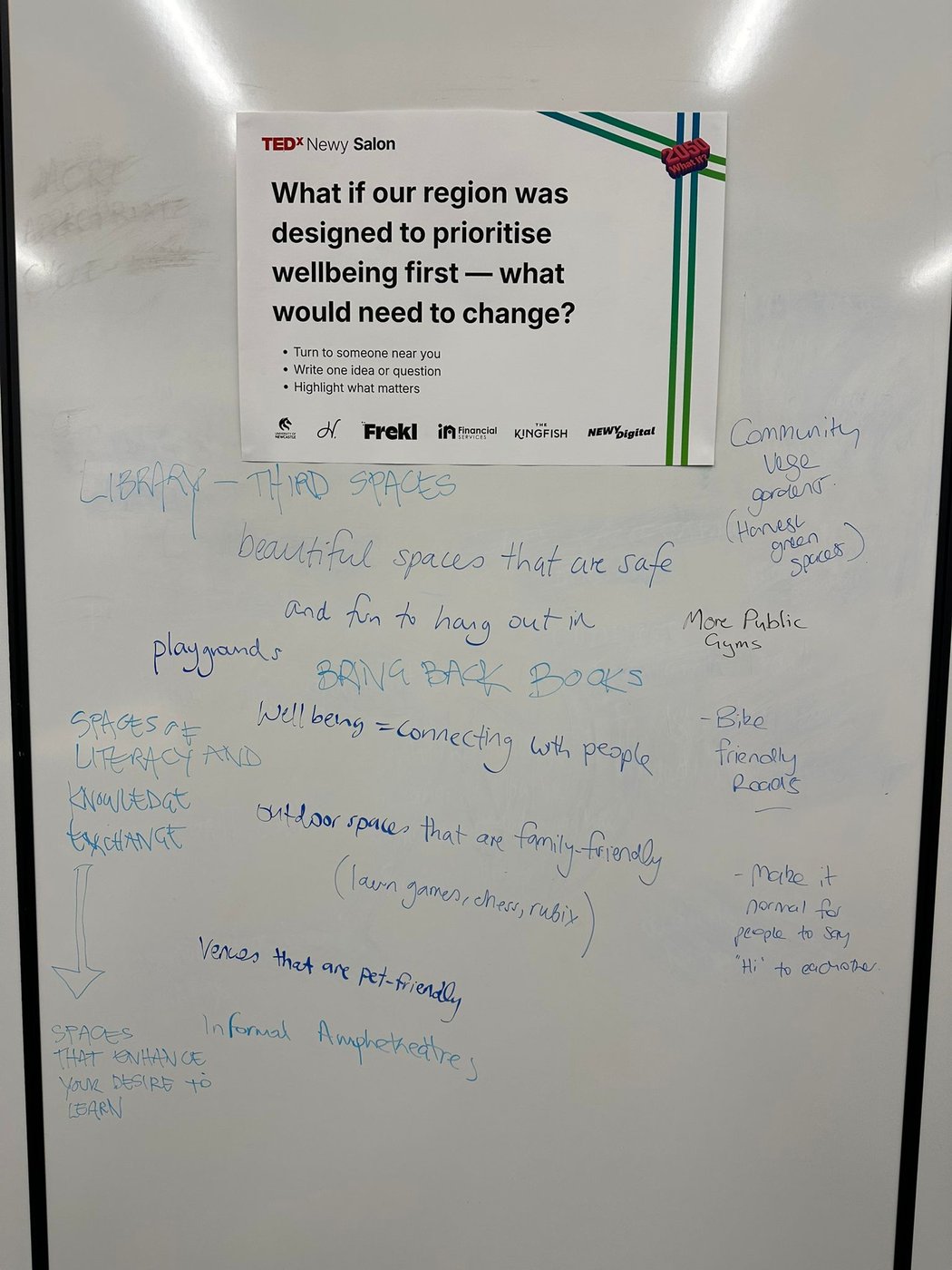
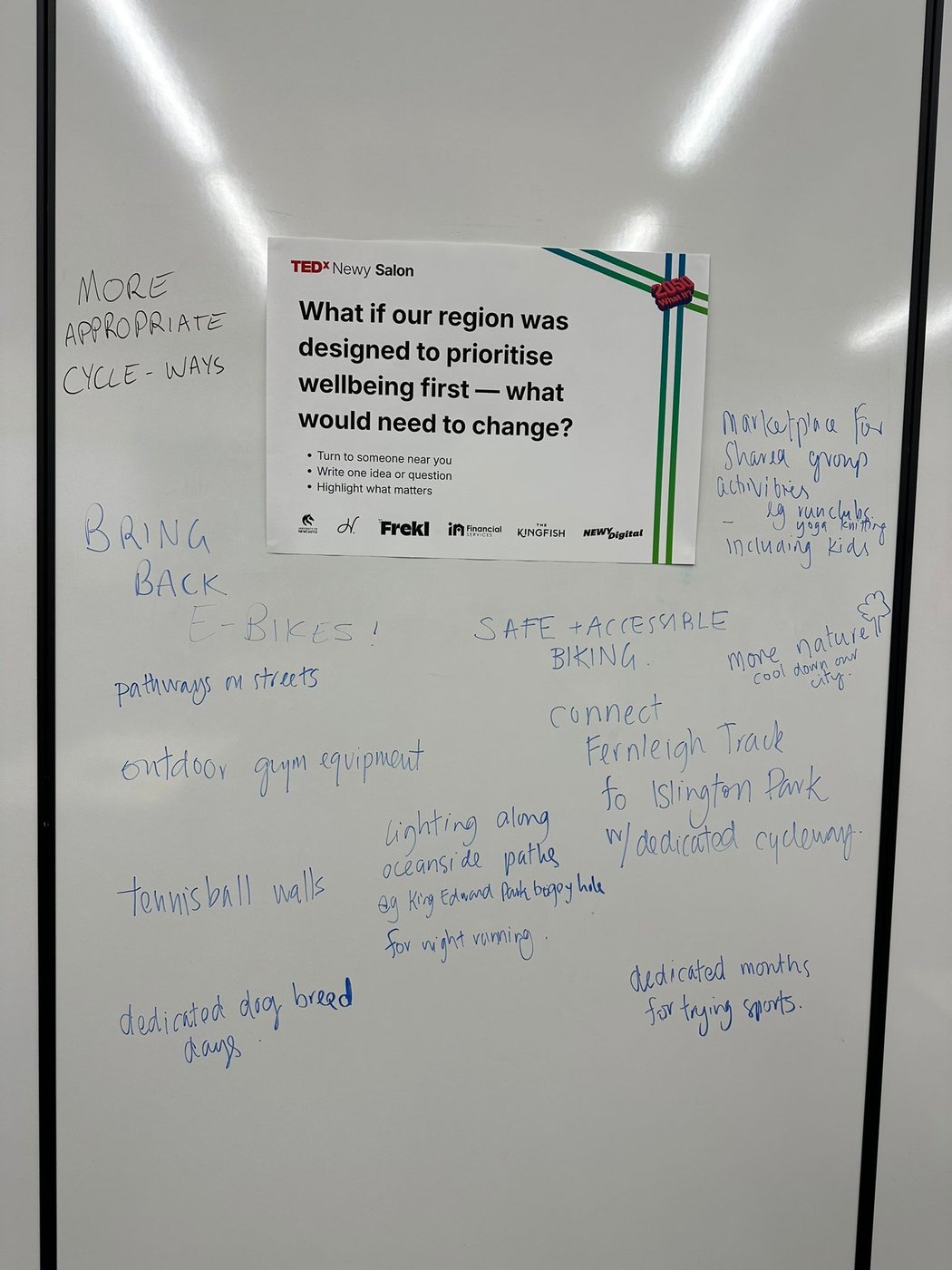
Two open whiteboards sat in the Health & Wellbeing room with the prompt above. Attendees added one idea each in blue marker. The responses naturally clustered into two streams — outdoor / active / connected, and third-spaces / knowledge / community.

Outdoor, active & connected 12

More appropriate cycle-ways
Safe + accessible biking
Bring back e-bikes!
Pathways on streets
Connect Fernleigh Track to Islington Park w/ dedicated cycleway
Lighting along oceanside paths (e.g. King Edward Park, Bogey Hole) for night running
Outdoor gym equipment
Tennisball walls
Dedicated dog beach days
Dedicated months for trying sports
Marketplace for shared group activities — run clubs, yoga, knitting, including kids
More nature — cool down our city 🌿

Third spaces, knowledge & community 13
Library — third spaces
Spaces of literacy & knowledge exchange → spaces that enhance your desire to learn
Beautiful spaces that are safe and fun to hang out in
Bring back books
Outdoor spaces that are family-friendly (lawn games, chess, rubix)
Venues that are pet-friendly
Playgrounds
Informal amphitheatres
Community vege gardens (honest green spaces)
More public gyms
Bike-friendly roads
Wellbeing = connecting with people
Make it normal for people to say "Hi!" to each other
Whiteboard 1 — outdoor / active / connected responses, written in blue marker around a TEDxNewy Salon prompt poster.
Whiteboard 1 — outdoor, active & connected stream
Whiteboard 2 — third spaces, knowledge and community responses, written in blue marker around a TEDxNewy Salon prompt poster.
Whiteboard 2 — third spaces, knowledge & community stream

Paper notes & post-its 92 notes across batches 1–3 (final)

Green & nature20

Yes! more green space ♥IMG_4535 · b3
Purposefully creating meaningful green spaceIMG_4476 · b2
Keep green spacesIMG_4484 · b2
Green SpacesIMG_4480 · b2
Green spaces near beachesIMG_4484 · b2
Native plants spacesIMG_4486 · b2
Street trees vibesIMG_4490 · b2
More nature → when we're moving and staying in placeIMG_4490 · b2
Shaded spacesIMG_4484 · b2
Animals (example being the new bypass)IMG_4476 · b2
Community-led green-space projectsIMG_4483 · b2
Calm down — protect weekendsIMG_4476 · b2
GlenrockIMG_4476 · b2
The beachIMG_4477 · b2
Any beachIMG_4479 · b2
"Active" ZonesIMG_4479 · b2
Reserved tree-planting spaces within green spacesIMG_4464 · b1
Carbon-neutral green buildings (high number of buildings with plants incorporated)IMG_4466 · b1
More tracks & spaces to do stuff @ Glenrock ♥IMG_4467 · b1
Protect — a healthier marine ecosystemIMG_4467 · b1

Aged care & intergenerational8

Childcare × aged careIMG_4476 · b2
Better aged care — alternatives to age well, celebrated & valuedIMG_4480 · b2
Redefine what aged care looks likeIMG_4486 · b2
More intergenerational connectedness in meaningful waysIMG_4484 · b2
Better connection between youth + elderlyIMG_4489 · b2
Multi-gen activities (e.g. aged care / TAFE to portal)IMG_4483 · b2
Integrate aged care with child careIMG_4461 · b1
More local community spaces in [each] neighbourhood for aged & lonely peopleIMG_4462 · b1

Loneliness & connection16

Having meaningful personal relationsIMG_4476 · b2
Conversational third spaces to encourage community engagementIMG_4477 · b2
Sense of "community" in your local neighbourhood — connecting with your neighboursIMG_4482 · b2
In Newy we say HI!IMG_4478 · b2
Feeling of "not alone" increases health → therefore communityIMG_4478 · b2
Relationships, loneliness — opportunities with dignityIMG_4482 · b2
More ways to live # solo / isolationIMG_4479 · b2
Community 3rd spacesIMG_4489 · b2
PLACES & SPACES where people can gather, organise themselvesIMG_4489 · b2
Community PicnicsIMG_4482 · b2
Communal pizza ovens — large wood-fired oven, bring along different dishes; the magic of community together is incredibleIMG_4483 · b2
Community (city-wide) Program to involve everyone across multiple activities and ideasIMG_4483 · b2
More group events / activities (ideally free) that encourage people to use the facilities — e.g. free beach yoga, group hikes, meet-upsIMG_4483 · b2
More mood-mix communal areas — pre-school / library / aged care — stop lonelinessIMG_4459 · b1
Public initiative to say "hi!" to strangers in nearby travelsIMG_4463 · b1
School of life campusIMG_4482 · b2

Equity & inclusion14

More inclusive — different abilities, ages / stages, races, religionsIMG_4478 · b2
The facilities for disabled peopleIMG_4480 · b2
DisadvantagedIMG_4477 · b2
Disadvantaged youth are missing outIMG_4478 · b2
Young PeopleIMG_4477 · b2
Greater visibility of First Nations cultureIMG_4479 · b2
Visible Aboriginal lore of the location ✓IMG_4462 · b1
Migrant and refugees community spaces (e.g. free yoga + group)IMG_4483 · b2
Community ServicesIMG_4477 · b2
Programs + places for men + boys — to create community + mental healthIMG_4485 · b2
Programs effective at addressing inequality + healthIMG_4485 · b2
By 2050, ZERO harassment of women & childrenIMG_4461 · b1
Safety in spaces (I want to run at night)IMG_4466 · b1
Community gardens — more involvement with diverse culturesIMG_4459 · b1

Active recreation23

MORE DOG PARKSIMG_4488 · b2
Newy health festival? — tour to active sites; gyms / health centres get to advertiseIMG_4484 · b2
Map that shows the health / sport options. Groups like Newy Active Co. that encourage active livingIMG_4488 · b2
Walkable town centres — places to stop in the shadeIMG_4478 · b2
Safe walking for daily tasks — interesting + comfortable + walking → ↑ healthIMG_4485 · b2
Brisbane Southbank — free large communal water parkIMG_4482 · b2
OPEN FREE PUBLIC SPACEIMG_4488 · b2
More EVENTS →IMG_4486 · b2
Outdoor / nature activities / experiencesIMG_4545 · b3
Healing peoples' souls — experiencing community through natureIMG_4536 · b3
Playgrounds (inner city) / Parks (inner city)IMG_4467 · b1
Bogey Hole / Bar Beach / Hobbys [favourite swim spots]IMG_4469 · b1
Bottom of Nobby's lighthouse beachIMG_4460 · b1
Ocean baths → connectionIMG_4467 · b1
BMX 🚵 [with hill sketch]IMG_4468 · b1
More wall ball / ball courtsIMG_4464 · b1
Subsidised rooms for gymsIMG_4461 · b1
NDIS-subsidised gymsIMG_4465 · b1
Free fitness classes (e.g. yoga, dance)IMG_4465 · b1
Floating saunas in the harbour (between tugs?)IMG_4461 · b1
5-min happiness factory — WALK HOMEIMG_4465 · b1
Art therapy sessionsIMG_4459 · b1
Support for other watersports outside surfing & nippersIMG_4462 · b1

Buildings & housing3

No mould in our homes, places of work, ALL BUILDINGS! → ↑ healthIMG_4486 · b2
Liveable housing means households are not financially stressed = ↑ wellbeingIMG_4482 · b2
More well-lit areas to create safety when outsideIMG_4490 · b2

Health system & policy8

Healthcare: NSW Health currently provides 80 contractual professional development tracks for in-work doctors but they pay for it. Factors-of-life, health risks, lifetime education, importance of social activities + education, all matterIMG_4491 · b2
Health is treated as such a side issue. Often the headlines aren't relevant to the patients — we want to make health feel less like a corporateIMG_4490 · b2
Ambassadors / holistic connectors — informed, empowered with creativity, that step back and look at the wider picture. Micro-health influencersIMG_4489 · b2
There's research, there's a trial, there's support — connecting the dots in health contextsIMG_4489 · b2
In Western Australia, all gambling [revenue redirected] to the community via Lottery WestIMG_4484 · b2
Not having to work so hard for so many hours to afford basic amenities or healthy foodIMG_4477 · b2
Share resources — do we need 50 washing machines in 50 [gyms]?IMG_4479 · b2
Queenstown [comparator place]IMG_4482 · b2
🪩 Topic prompt How will we experience the city after dark in 2050?
5recordings
~67minutes
~10,500words
88post-it notes

Key themes

Lighting, perception & the politics of safety

"Lighting, safety and perception are the biggest ones to tackle." Calls for artistic lighting (Singapore mentioned), more activity to dilute anti-social behaviour, and a wariness of media-shaped fear vs. the actual reality of a place.

Foundational

Newcastle is a string of disconnected pockets

Darby Street, Beaumont Street, the foreshore, Hamilton, Wickham — beloved precincts that "feel close, but not". Lighting trails, walkable connectors, transport links and night markets all surface as ways to thread them together.

Spatial pattern

14–18 year olds and 30+ year olds are both underserved

"18 to 25 is pretty catered for. Where's 14 to 18? And then it's 25 plus." Two demographic gaps named explicitly — the kids "on the street with nowhere to go" and 30+ adults craving small-plates wine bars over King St chaos.

Demographic gap

Lower the bar to bar — pop-ups & Special Entertainment Precincts

Recurring frustration with DA cost and complexity ("$120K per business in fees"). The Midtown Special Entertainment Precinct is held up as a structural fix — one shared licence, lower individual cost, faster activation.

Regulatory

Cost is reshaping the night

"Students are working four jobs and trying to keep food on the table — they're not drinking." A $35 family coffee outing. Gambling revenue from Gen Z dropped from $31m to $3m. Behaviour change is partly economics, not preference.

Affordability

Family-friendly nights are a market that's growing

"Parents want to go have a beer, watch a band, let their kids be more old." Adamstown Bowling Club repeatedly praised. The case is made commercially: "four dads × eight beers" if venues are kid-tolerant.

Opportunity

Phone-free, IRL, social

Urban Distillery's stickered-camera night is held up as the format people want more of. "We're social animals. COVID taught us that." Disconnection-as-feature — a small but vivid sub-theme.

Format

Activate the heritage backlog

Newcastle Post Office, Cambridge, Argyle House (Fanny's), Marathon site, Newcastle Station — repeatedly named as buildings whose long-stalled redevelopment is shaping the night experience by absence rather than presence.

Built fabric

Run clubs > nightclubs

"Now we've got more run clubs than nightclubs." Wednesday student nights have disappeared. Behaviour is moving toward dispersed, dry, daylight-adjacent socialising — the question is whether the city catches up or fights it.

Behaviour shift

Nature-at-night is a Newcastle superpower

Late swims at the baths under a full moon. Glowing fungi at Glenrock. Night bike rides. Cinema under the stars. Free or near-free, distinctively Novocastrian, and barely on the city's official map of nightlife.

Distinctive

Demographic shift in the CBD

"The majority of people buying apartments in town are 65+." Some buy multiples and run them as Airbnbs. Cafés thrive on weekday spend; vibrancy at night doesn't automatically follow density. Who actually lives here matters.

Demand-side

Outdoor music & an amphitheatre-shaped hole

Multiple operators flag the absence of an ideal outdoor live-music venue (5,000 cap territory). Foreshore festivals work; the Station precinct is shifting to F&B. The Victoria Theatre opening is anticipated as a lift for the East End.

Infrastructure gap

Light is the connective tissue of the night

Post-its return to lighting again and again — artistic, functional, safety-shaping: "lighting + the presence of people make a place feel safe"; "community parks with diffuse lighting connecting hotspots"; "coloured foot paths to connect the city"; "Vivid lighting show"; "unprogrammed busy spaces — lighting work"; "beautiful artistic lighting".

From post-its

Suburbs deserve their own night — not CBD orbits

"Neighbourhood / suburb night life — enhance, rather than the focus of one precinct only." "HUBS in SUBURBS." "A village square in each neighbourhood." "Western hub." A clear push to decentralise nightlife into where people actually live.

From post-its

Late-night transport is the unlock

"Make the light rail FREE on Friday, Saturday & Sunday nights, e.g. 6pm–6am." "FREE TRAM AT NIGHT." "Light-rail that runs past 9pm." "Cheap / free transport @ night." "Maxi / Taxi / FREE BUSES." Repeated as a precondition for everything else to work.

From post-its

Non-drinking nightlife as explicit design intent

"Non-drinking culture", "Festivals — good bands, not alcohol", "Pre-drinks at home — cheap entry — drink deals" framed as a strategic counter, "Phone-free events", "6-course dining in a fancy restaurant", "Night-time bakeries / cafe crawls".

From post-its

The waterfront's untapped night potential

"Beach front wine bar (can use picnic rug)", "More picnic tables overlooking coast", "Outdoor cinema, but for adults — wine and luxe bean bags", "BYO at views — drinks on harbour", "BBQ in laneway", "Let cruise ships dock & not leave till midnight". Specific, vivid, placed.

From post-its

Age-bracketed venues, named explicitly

Post-its echo the audio's demographic gap with structural specificity: "Venues for age brackets — 14–17 / 18–25 / 25+", "EAST END Development — age group 65–85", "Venues that are kid-friendly", "What should exist: late-night arcades, VR centres, games + entertainment alternatives to the harbour".

From post-its

Fix what we have before building new

"Increase quality of what we already have, rather than abandon what is already built." "We don't actually need to spend much. Newcastle — what we have, we just haven't activated yet." A repeated economic frame against capital-heavy answers.

From post-its

Visualisations

Where you marked the night map

During the salon, attendees placed yellow glow-stickers on a printed map of Newcastle East to mark points of interest, places they value, and places they wanted to see activated at night. Stickers were detected from a photograph of the salon table, hand-cleaned (false positives removed), and re-projected onto the original map design — 83 markers in total.
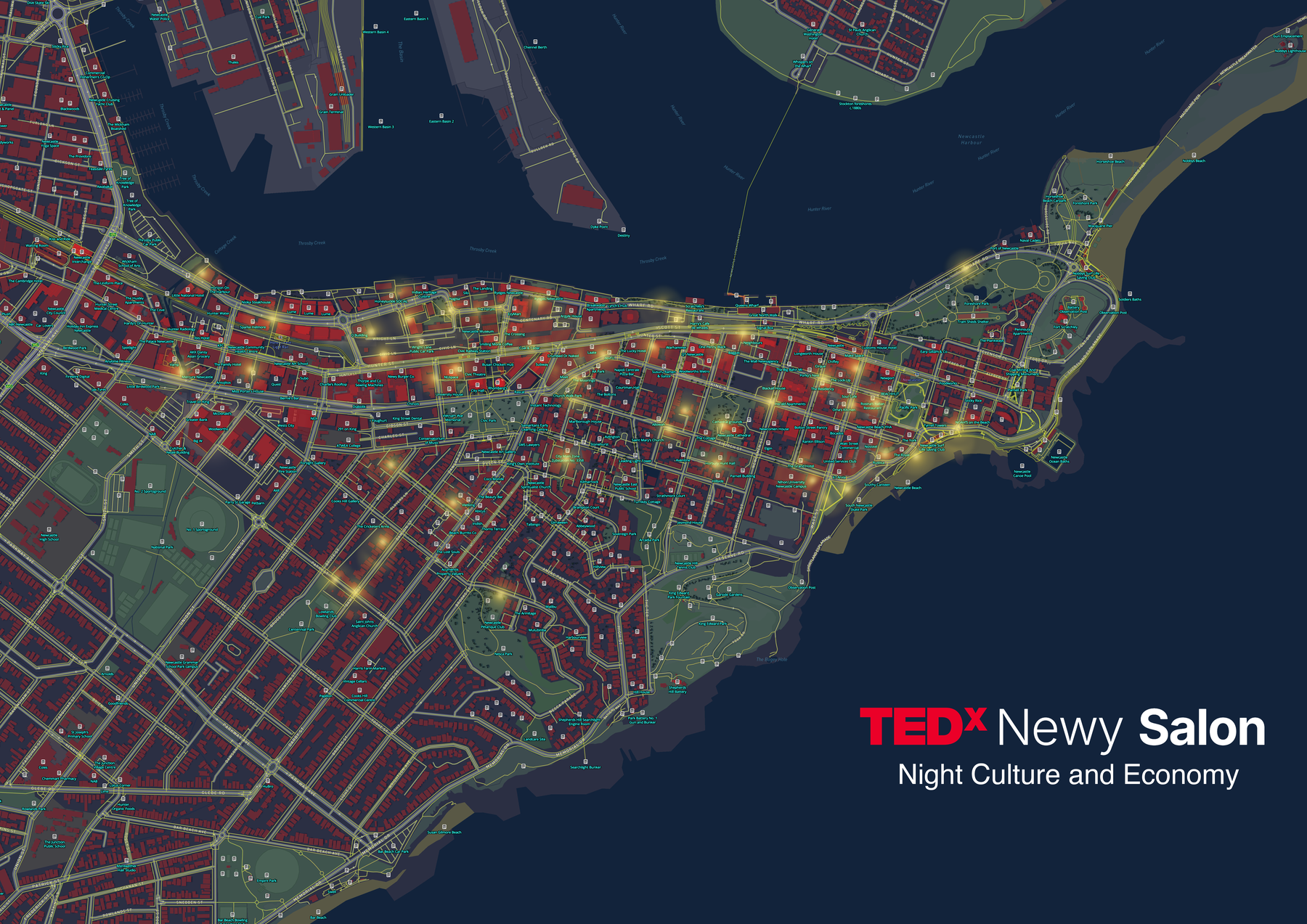
Yellow glow-map markers placed on the Night Culture map of Newcastle East — densest along the foreshore, on Newcastle East peninsula, and through the CBD streets.
What the glow shows. The thickest band runs E–W along the harbour foreshore and Hunter Street — the spine of the city's existing night activity. A second strong cluster sits on Newcastle East peninsula (Fort Scratchley / Bar Beach / Camp Shortland). Scattered markers follow the residential grid south of the CBD, with smaller pockets on Stockton (top) and at Honeysuckle. Sticker placement was approximated from photo to map via a 4-point perspective transform.

The U-shaped service gap

A consistent pattern in the room — Newcastle's night currently caters strongly to one band of people, leaving distinct gaps at both ends. The y-axis is "how well served," qualitatively, from the conversation.

Well served ↑ Underserved ↓ Under 14 Almost nothing 14–18 Big gap 18–25 Well catered 25–35 Foodie scene 30s+ parents Patchy 55–65 Cafés, OK 65+ at night Falls off

Most-named places & venues — audio + post-its combined

Mentions across audio transcripts and post-it text (case-insensitive, related terms grouped — Argyle / Fanny's together, Hunter St / Hunter Street Mall together, etc.).

The Lass O'Gowrie11
King Street Hotel9
Newcastle Station / Station Development7
Hunter Street / Hunter St Mall6
Argyle House / Fanny's6
Civic Theatre5
Victoria Theatre (anticipated)5
Late-night swims / baths6
King Edward Park4
Honeysuckle4
East End / East End Development3
The Wharf3
Adamstown Bowling Club3
Cambridge3
Newcastle Post Office3
Wickham3
Glenrock3
Bar Beach / The Junction3
Darby Street3
Stockton (ferry pier venue)2
Hamilton2
Mayfield / Adamstown2
Tower Cinemas1
Devonshire St1
Newcastle Uni (in-town buildings)1
Western hub1

✨ Working / loved

  • The Lass O'Gowrie "At capacity most weekends, going to 3am" — table tennis, queer-friendly, the standout
  • Adamstown Bowling Club Praised as the family-friendly model others should follow
  • Civic Theatre Anchor cultural venue
  • Late-night baths swims Free, full-moon "super busy" — repeatedly named on post-its
  • King Edward Park Cleanrock; "Disney outside, all year" — strong activation signal
  • Tower Cinemas / Gallery "Good recent activation" — post-it
  • Foreshore festivals (New Annual) "Took the kids — they should do that all the time"

⚖️ Mixed / shifting

  • King Street Hotel Beloved 25-year venue, but "not for everyone at a certain point"
  • Newcastle Station / Station Development Transitioning to brewery + restaurants — "create activity"
  • Victoria Theatre 1,500-cap venue anticipated to lift the East End in ~18 months
  • East End Development "Age group 65–85" — explicitly demographic-targeted
  • Honeysuckle Daytime success, e-bike conflict, residential pushback; post-its: "block Drive for weekends"
  • Darby / Beaumont Loved precincts but "isolated pockets"; post-it asks "Make Darby St pedestrian access only"
  • Special Entertainment Precinct (Midtown) Could save businesses ~$120K each — pending council vote

🔒 Stalled / closed / underactivated

  • The Wharf "The Wharf needs to change ✱" — explicit batch-3 ask
  • Hunter Street Mall Post-its: "to re-vamp, needs to be popular"; "potential for bars + vibrant installations"
  • Newcastle Post Office "Beautiful sandstone… DA just activated by sledgehammer", years stalled
  • Argyle House / Fanny's Closed quietly — "rite of passage gone"
  • Cambridge Shut down
  • Marathon site "Why are we not activating that space?"
  • Devonshire St (Coast) "Disused — potential for lighting / public art"
  • Roxanne's, Blue Kahuna's Closed — the in-town strip has gone quiet
  • Tuk-tuks (legacy) Operator-led, beloved, never replaced
  • Wednesday student nights "Three venues running them — not one exists now"

Voices

Lighting, safety and perception are the biggest ones to tackle. — participant, Night Culture session
Newcastle is very much missing youth venues. Because the kids are on the street causing issues. There's nowhere for them to go. — participant, Night Culture session
Now we've got more run clubs than nightclubs. — operator, Night Culture session
We were thinking about opening a little bar on Hunter St last December — but it's so expensive and so difficult to get a bar licence. — participant, Night Culture session
Students are working four jobs and trying to keep food on the table. They're not drinking. — participant, Night Culture session
Late-night swims at the baths. At full moon. The full moon down at the baths is super busy. It's great. — participant, Night Culture session
Newcastle's funny, 'cause it's sort of like — we've got Darby St, Beaumont St, the foreshore. It's in these little isolated pockets. — participant, Night Culture session
The majority of people buying apartments in town are 65 and older… how can you make it easier for families to get into town and be part of that culture? — participant, Night Culture session
It'd just be cool to kind of have more of those — there was one at Urban Distillery a couple of weeks ago, they block out your phone when you're in. And you talk to people. — participant, Night Culture session
I would go out at night if there were nighttime activities in nature — like night diving, or going out and looking for glow-in-the-dark mushrooms in Glenrock. — participant, Night Culture session
These memories stick — and it's like, well, I don't have the confidence to go out. Because I've had that many experiences where I've either been stranded and can't get home, or it's been a dud vibe. — participant, Night Culture session
Most businesses are pop-ups these days — they struggle. But why not support actual pop-ups? — participant, Night Culture session

Raw transcripts

Methodology note. Transcribed locally with whisper.cpp (large-v3-turbo, English). No diarisation or speaker labels. Whisper occasionally loops on quiet stretches — you'll see runs of "Yeah." or "It's cool." in places. Themes above are based on the substantive content only.
Night Culture — ZOOM0001 ~9 min · 1,566 words
Especially like parks and stuff. Let's assume by 2050 we've cracked fusion energy and energies too. Especially in winter, I come from a tropical country, so when it gets dark early I go like, you know, I need more sunlight. What if we could light up places like parks to be like almost like certain parks away from houses. It could be almost like daytime kind of thing. So if I miss it out in the morning at work, I can go after work, I can take my kids to a place that's almost like a sunlight. We work in offices, by 5 o'clock I come out and it's dark, I'm going to be like, I missed out on lighting. How much do we consider the natural world with that though? Because that will disrupt the innocent reptiles and other... Yeah, that's true. Like for a night time economy, for me, I'm not a very going out at night person. But I would go out at night if there were nighttime activities in nature, like night diving. Or going out and looking for like glow in the dark mushrooms in Glenrock, for example. Things like that, like how can we get people to enjoy nature in all the different contexts from daytime to nighttime. Because there's so much that comes alive. I'm there as well. In 2050, I feel like I would like to see a vibrant city, but at the same time, still have a really thriving, biodiverse, rich ecosystem in... Yeah, yeah, yeah. Bike rides in Glenrock at night. I used to do that quite a bit. It's quite an experience. Yeah, okay. Alright. Who wants to go next? No? Want me to read it out? What makes a place feel safe and welcoming at night? It's definitely down to the lighting. Lighting, yeah. Because at Newcastle West in particular, like one national, a lot of those people moving in there are baby boomers. Yeah, yeah. But they don't feel safe in the area, so there's lots of exceptions around McDonald's. There's lots of crimes, lots of work. There's not much police presence. And it's also really hard to see around that marble town at night. Yeah, yeah, yeah. It's also hard for them to commute from Civic Plaza up there and help go through all those sections of registration. Yeah, okay. So, a lot of that is safety and perception. And same way at the beach, so you have a lot of Muslims go there after dark. And just being able to transcend along that waterway and along the beach, more lighting or even artistic lighting. Like in Singapore or overseas, you'll see a lot more artistic lighting, so it doesn't just wrap the birds. Yeah, yeah. But it brings activity there. But yeah, lighting, safety and perception are the biggest ones to tackle. Yeah, okay. Recently they decided to put surveillance on the street. Yeah, I did read that. Would that change your perception of safety? Did you say surveillance? Yeah. Only if something actually happens with it, and I think that's a challenge. And I do think sometimes our perceptions are out of alignment with the reality of the situation. And I think, you know, there are certainly parts of the media that feeds the negative. And I think we are probably hearing more than we used to. And therefore, you know, the negative feelings that come with that. So I think you always have to be sifting what is reality and what is just news. I am very, very close to the CCTV thing. It was driven by the Business Improvement Association, which is funded. So that's my main goal is to look after businesses. And I've only joined the city in October. Since every single meeting I've been there, the business is there. We need CCTV. We need CCTV. Like, someone has done this to my window. Someone has done that to my window. Yeah, yeah, yeah, yeah. The hope is knowing that people are being observed, it's going to change. It's access to territory. And the funny thing is a lot of the issues that come up don't really happen at night. It's during the daytime. Yeah, yeah, yeah. When there's less people around in Vermont Street. When night, when there's a lot of people around, the anti-social elements typically can be pulled away. Yeah, yeah. It's a lack of people that makes them a bit more involved. Which goes back to the question. What would make you consider a lot of people? Yeah. People. Yeah, people. Sorry, my point is I feel like for a lot of people night life is drinking. Yeah, yeah. It's definitely a more safe environment. I feel like there should be some healthy activities. Either something related to nature or sport or something. Yeah. So it's a perception issue. Yeah, perception issue. And it is reality as well. They are coming straight out of the park. Yeah. To the streets. So if you are 75 or 80, you don't... Yeah. I do think that critical mass of people does shift that way. And I think if you think about a city like Brisbane and the south north area, you know, the pubs are definitely there. I mean, Brisbane is a city that's not unlike Newcastle in some kind of southern terms of its culture. So the pubs and the drinking is there, but there's so many people in that area with so many different reasons. The views and the restaurants and the events that happen there. But I think, you know, because there's that balance of older people and families, you're going to make it feel more dispersed on the number of people who are there for the drinking culture. Yeah. All right. Well, that actually links into this question. Because we're mentioning sort of, you know, older people. Who does Newcastle's night currently serve well and who is in the village? Well, it serves going out to drinking fans. Going out to drink fans, I guess. Yeah. And foodies. It's a good foodie place. Yeah. There's a lot of good restaurants that are well known. Darby Street and Honey Sutherland. Yeah. And that can sort of, I think, from possibly studying the Darby, you know, 60 and under, maybe the older generation above that aren't as comfortable. I'm not too sure. But I guess the problem is we've done developments and price points where the majority of the people living within Newcastle CBD now, aren't families. They're prestatiously. Yeah, yeah, yeah. So the majority of people buying apartments in town are 65 and older in the town. They've got huge money, which is great to spend. Yeah. But it's like, how can you make it easier for families to get into town and be part of that culture? Yeah, yeah, yeah. Yeah. I mean, yeah. Like, yeah, real estate and pricing of real estate and all that sort of stuff is a big issue. And how do you cater to different demographics is a good solution? Well, just the ease of access. So families do come in. Is it unprogrammed, like, spaces that aren't going to cost you? Yeah. Someone complained a bit the other day about this. I know Sonny Boy and they're in the park. They said, as a family with my two kids, I went there. Coffee's a nine bucks each and then we had to buy a sandwich. And they were like, well, that was a $35 card. Yeah. Yeah, yeah, yeah. Yeah. So if we are talking about families coming in, yeah. And is it, like, is the park going to be lit at night? Is it successful at night? Is it all the pictures going to work at night? Yeah, yeah. Day? What was that? I said day. I said day. It's nowhere to go with it. Yeah. Well, I can tell you, the one recent business that actually said that they are doing very well recently was Escaping. Hiya. In the city near Towers of Massim. Yeah, yeah, yeah. They're like, it's great. You know, we're getting more demand. I'm like, ah, okay. This, I guess, goes back to my original point where it's about changing the product to meet the customers. Yeah, yeah. Who it leaves out, I would agree. With children, I would say, if I had my kids around, where would I take them at night? Besides the movies, not much. Yeah. The new park, will that have lighting and everything? Is that successful at night? The new park, the park, is that the stage? I don't know. I'm not sure. I'm not sure. I'm not sure, actually. Because that's going to be fantastic at night. Yeah, that would be a perfect place. And then you've got the station, you're going to have the brewery and all the restaurants in the station and the redevelopment of the wall. So that's going to bring a lot of people to that precinct. Yeah, yeah, yeah. And then you've got the rest of the stage three east end coming together and that will clean up onto students. Yeah, yeah. Well, maybe we can, just to break it up a little bit. Do we want to each take a token and let's have a vote of, ah, guess what we think's important? - Good morning.
Night Culture — ZOOM0002 ~2 min · 266 words
I do like those undercutors, how bummed are we that sports girls got down in there? Yes, yes, yes, what's left? The thing is, where are we not including Vermont Street? So yeah, Vermont's out, so it's just, yeah, Newcastle, it's like a street mall. Yeah, it's like, where's the street mall? It's just like, probably looking right at me. Oh, so there. Oh wow, excellent. Okay, so yellow is, yellow is open. It goes to Newcommon Street. Yeah. So it ends there at all. Yeah, we're thinking here. That's the part. Yeah, that's the part. And then obviously write down anything you feel Newcastle is missing. So, lacking. Lacking, yeah. One thing for me personally being in, obviously, the all-time economy and also events and music festivals is an ideal outdoor space to watch the live music show. Yeah. Whether it be 5,000. Yeah. Whether it be 5,000. When we're kind of, we're in discussions with the council, like, where is the ideal space to put that? I mean, I'll put shows on at the, at the, at the station, but that's now being taken over. It's got a new lessee that are going to be doing, like, the Gastroparb and F&B. Yeah. You know, I've done a festival down here on the foreshore, which is good, but thinking of, you know, large events bring people into the city that obviously activate the night-time economy. So they're good for so many reasons. Yeah. They can be disruptive, but, you know, for me personally, like, if I was having my ideal night out, it would be...
Night Culture — ZOOM0003 ~17 min · 2,262 words
Yeah, yeah. Excellent. Any other ideas? It's like a Sunday, Sunday, whatever it is, and it's like once a month, and all the vendors just get to come into different restaurants, and we've got a little market, and it's shut down, like, Key Street is walking over, and everyone just gets to bring their food back and go nuts. Yeah. Anybody else? Any other ideas? I think it would be cool to have, maybe like themed in a way that's not like a place that you go, but like a phone-free event of sorts. Oh, I like that. I went to one of those. Sorry. Yeah, they're great. Everyone can kind of like, everyone's got technology everywhere, like everything, and it's a beautiful thing, but it also treats us in the foot. Yeah. You know, it'd just be cool to kind of have more of those sorts of, there was one at Urban Distillery a couple of weeks ago, and they like, they block out your phone when you're open. Little sticker on the back. Like your cameras, and like obviously that's like the four wall stints in it, but I don't know, it's just cool. And you talk to people. Yeah, yeah. Yeah, cause I mean, we're social animals, yeah? Yeah, yeah. COVID taught us that. We need to interact. So generally you need someone to drive this, right? Yeah. You need someone to get in there and actually burn the boats and do the thing. Definitely. So. The thing we were talking about in the previous group was, I actually, so I was born here and raised in Newcastle. Newcastle's funny, cause it's sort of like, we've got Derby street, the Bowman street, the foreshore. Yeah. It's sort of in these little isolated pockets. And we were talking about, wouldn't it be cool to have like, even things like colour football and lighting that connects it all. Yeah. Absolutely. So you generate like those interconnectivities and network effects that generate critical mass. Yeah? Yeah. Yeah. Do we want to consider some more sort of questions? Let's have a look. Yeah. Ah, this is a good one. I like this one. What night, particularly in an era of inflation, yeah? What nighttime experiences matter to you that don't involve spending money? Zero. Karaoke. Yeah? You've always got to spend money? The late night swims at the baths. Ahh. Excellent. Love that. At full moon. Today's a good day. Yeah, yeah. Yeah, it is. The full moon down at the bars is super busy. It's great. A late night bike ride. A late night bike ride? Yeah. Yeah. What else? But even a pre-contra media, there's a pretty big part of it. They do. Yeah. The cinema under the stars events happen. Yeah. Definitely. Yeah. I mean, one thing with that is then it links into things like transport. Yeah. Yeah? How do we get there? How do we move from, if you live in the suburbs, like me, you've got two kids. How do we get from A to B? I think that's a very important thing of like, how do we get from A to B? Yeah. How do you get things going in the suburbs? Yeah. Because it can't just be in the city. In the city. Yeah, yeah. So it might be, like with the Fringe Festival there's like, loads of things happening at like, in the suburbs as well. Yeah. So that might be something to like. Yeah. So try and build like a hub in a sort of suburb? Yeah. Like March is merry weather month and there's things happening. That's a great idea. Yeah. March is merry weather month. Yeah. Okay. Yeah. Yeah. Of course. What other questions do we have here? Ah, so this is basically the opposite. What night time experiences are you willing to spend money on and how much? Live music. Live music? Yeah. Yeah. Yeah. Yeah. Yeah. Yeah. Yeah. Yeah. Yeah. Yeah. I'd love to go out. Yeah. Yeah. Yeah. Yeah. It's so awful. Oh. There's a whole bane. Yeah. There's plenty of places. There's the Lass, which is amazing. The Lass is queer friendly. It's gorgeous. But like, when it's pissing rain and there's only a beer garden, it's kinda hard to be like. Is it? Yeah. The Lass. The Lass O'Gallery? Yeah. Right there downstairs. It's in Wickham behind the train station. Wickham? It's really fun. Wickham. It's like right behind. It's like next to the interchange. So if you come out of the interchange from Sydney, you turn left and then you walk up those streets there. The basement, the underground? There's jazz, jazz jazz. But then if you, yeah, King Street is like 18 year olds. 18 to 24. And it's like when you're in your mid-30s class, you're like, I really want to, King Street. King Street, yeah. It's like an over 25s club actually. Underage venues as well. When I was growing up, I used to go to like underage discos. Yeah. At the moment, Newcastle is very much missing youth venues. Yeah, or even just. Because the kids are on the street causing issues. Yeah, yeah, yeah. There's nowhere for them to go. If they don't have where to listen to music, they have nowhere to go. Well, it's like 18 to 25 is pretty catered for, right? Yeah, where's 14 to 18? And then it's like 25 plus, and then 14 to 18. So it's like, I want to go out and listen to bands. I don't want to go to King Street and deal with someone that's vomiting on their shoes. Yeah. Or vomiting in the line. Or who's had like OD. It's like, I've been there, don't have fun. You go to the Rogue or Bernie's or Charlie's. Yeah. That's the whole part. Is there, someone was telling me, so I remember when I was going out, not that long ago, but there was like student nights. Are there still student nights? No. No, there isn't. Students are working four jobs and trying to keep food on the table. Yeah. Right. They're not drinking. They're not drinking. They're not drinking. They're not drinking. They're drinking. They're not drinking. They're drinking. They went from like $31 million in revenue from gambling to $3 million in Gen Z. Yeah. Which is wild. Which is funny because. I put up this prompt here. Like what would an ideal look like for a 17 year old who doesn't want to drink? Yeah. Which is quite a common kind of type at the moment. Well, they're also like at the bars and they're like, they're ordering, ordering matches and they're sitting there listening to music on their Yui Booms. Like they're. Yeah. That's. They're in the bar. Or in Australia. I feel like there's a lot of space lacking in Newcastle for them. Yeah. Yeah. Absolutely. They go to the bars, they go like around Manchester. Yeah. I don't know. Yeah. Like they're lacking those spaces that are, that are cooked, right? Yeah. They don't want to spend money either. Like it's either spending money. Or they don't have money to spend also. Yeah. Yeah. And that's what they've noticed that when, when Gen Zed, especially older Gen Zeds actually get into jobs where they have money, they do start drinking again. Yeah. It's just that they can't afford it. It's just that they can't afford it. Yeah. That's the only thing stopping them. It's not a moral thing. Yeah. Which they can't afford to. Yeah. Okay. I mean, I guess that's sort of links in this. I mean, yeah. What makes a place feel safe and welcoming at night? Lighting. People. Exactly. Yeah. The culture. Yeah. Yeah. It's like a critical movement. Yeah. It's like a critical movement. Yeah. They need less laws. Yeah. Make it easier to get a license for a pop-up bar. Yeah. Yeah. And like seats on the paper and stuff like that. Yeah. Yeah. Yeah. Yeah. It is absolutely. It is absolutely. It's a business. And that welcomes people to the area. It's a very safe place. The public wants this. Like, Laura and I were thinking about opening a little bar on Hunter Street in December last year, but it was like, it's so expensive and it's so difficult to get a bar license. And we wanted to do it for summer. Yeah. Just to be like, small plates, nice wine from Vera wine, and it's like a super cute Parisian bar. public want this like Laura and I were thinking about opening a little bar on Hunter Street in December last year but it was like it's so expensive and it's so difficult to get a bar license and we wanted to do it for summer just to be like small plates nice wine from Vera wine and it's like a super cute Parisian bar and people want that and people that are like you know 30 plus want to have that you know like they want to do that they're like get a babysitter for the night let's go have a cute dinner and go out for a dance whatever so it's finding those little things we need more variety but like the council needs to also allow people that have these ideas and these this vibe and they want to bring the vibrancy back into Newcastle to be like can we do this okay that's what we're working on in Midtown with the special entertainment racing so New South Wales state government have a way of classifying an area not individual DAs so if you're in that area you just follow the one DA so everyone can use sound up to a certain level everyone can use internal staircases like some of the criteria on DAs like some say they can't serve energy drinks some aren't allowed to have mirror balls in there like because it's just ridiculous so mirror ball yeah mirror ball like a disco ball everybody wants one bar why is a disco ball print um there was some weird thing where some of them thought it was an epilepsy race ah um yeah so there's all of these things so basically you can do one special entertainment precinct license anyone within that area can follow that license so if you're a business or own a business within that area you just follow that license and that saves about it saves individual businesses about 600 or 120 thousand dollars per business in fees for DAs, sound reports, engineering reports, all of that sort of thing so at the moment it's currently being discussed by the council because it has to be passed by council in order to enact that state government stuff in New South Wales yeah but could it like if you know it's like a new idea of just having like in like a city centre or something like experimented in zones well that's that would be what that zone is you could then open up you go to this zone you know exactly what it is you just follow what it is you don't have to do like yeah and also have like month on so it's like if someone has that business and an empty venue and it's so good yeah you know we activate different products yeah also look for the person that owns like a landlord they're going all right cool every three months i have a new person coming in and paying this rent it's a consistent rent with a different vibe every three months yeah i think that's really good what's that like what hunter renew or a new renewal yeah that was like well they should renew renew yeah what if you crowdfunded like it would be the type of thing where it's just like okay you want to do a pop-up or pop-up yeah let's call it a pop-up and it's just like oh well i want to do that like shit is anyone going to show up well what if you like had some sort of website and it's just like okay when a thousand people bought a drink they bought a ten dollar drink yeah and they get a voucher they get a voucher and all of a sudden you've got a thousand people thousand people send you a ten grand you're like all right well i know well now that's the fit out yeah exactly but you know what i mean i get enough of that and it's kind of like it depends which venue you're going into though like to be honest we started burning our credit card yeah like we we had not much money at all we talked to the landlord into giving us zero rent for the first three of months and no bond yeah and we just like bring it to us and it happened she said you know what fuck it yeah let's go we could show the idea and we were able to start the bar but they've also got an amazing landlord there's so many landlords right absolutely not yeah too much risk what if it flops and then i'm out of pocket and then my venue's being damaged yeah exactly there is a lot of things we've got about ten minutes left in this room i encourage you to maybe make a little swap or maybe have a look over there in the back if you haven't yet and just
Night Culture — ZOOM0004 ~3 min · 321 words
You can attract a lot of people with a couple of food trucks and a margarita van. If you're at home one day and you've got a food idea, obviously you can go over to New York and all the food trucking, that's where the fads start. It's an idea. A big focus on Queen's Wharf, they're doing some work there. They had it at Surfest, there were those food trucks and they had a nice Statenwood beer at 10. That was lovely. If they hadn't done one time, that would be amazing. That's during the day and night time, that stuff can exist as well. Late night markets, food, people experience the city, they start at 5, go home at 10 or they go from 10 o'clock to 3. At our venue we have a night called In Med Before 10 and it's designed now, people go out, they have dinner, they drink, they come and dance in the nightclub and they leave a tent and garden. People are experiencing it differently. What venue? It's King Street, I own that one. So I have that, Argyle House, which is Fanny's, we just have the Cambridge, we've got a bunch of restaurants and I do festivals. I do Howland Country, I do some events at the university outdoors there. They were talking before, one of the girls was talking about how she goes to King Street Hotel even though she's in her thirties because she loves the live music. Yeah, there's a part there. And that's what I love about the Barbeach part thing, you know, they have young guy, young girl, whatever, duets, singing. Just pop up in the park and sing. Yeah, and so many people are there. There will be more, like obviously Victoria Theatre is opening up soon, which will be a live, which will be a theatre. you know, that's, that'll be, uh, uh, you know,
Night Culture — ZOOM0005 ~29 min · 6,101 words
It's a typical night out for you and what I'd like to do is if you've lived in Newcastle for a long time, your night out when you were 18 to what it probably is now would be significantly different. So some people are going from 5 to 10pm, what does that night look like? Then from 10 o'clock to 3 o'clock is a little bit different. So what we've been trying to do is what your night would look like and then also what's a good kind of idea is like if you had someone in a state or has ever been in Newcastle, what would that look like? How would you show Newcastle off to them? I know what I know exactly. I know the roads I go down, I know where I take them and I reckon most people would probably bring them around here, down to Horseshoe, along the wharf and we show them all those spots. I park up interchange and catch the light well through the city just to kind of explore it. So, you know, you can either, you can start with that, what that ideal journey would be or also what you typically do. I just find being locals, like, you'll just do, you go, oh, that's what I do. I go to that bar and that restaurant and I go home. Then maybe think about if there was an event on, if there was an outdoor show or something, how would you navigate through the city, you know? And then if you had something like identify the red, where's a place where you particularly probably wouldn't go or wouldn't recommend? And then the blue is something that has future potential. Where's an area that you think we should explore more, whether it be down Queens Wharf where we can put a bunch of night markets or it could be little food pop-ups, things like Queenstown have a really good, on the water they've got all these like little food kiosks so that people can go in there and try new cuisines and things. Like maybe that could be an area that we need to put some movement in. It could be, oh, people have been putting stuff in Stockton where they just think it's beautiful and fair, but there's nothing there other than the kids' park, you know, outdoor bars and restaurants. And these are just ideas. If you think there's a future potential with the blue, pick up one of the cards and also write down what that idea might look like and drop it some ideas of being outdoor amphitheatres, like a live music kind of thing, the city kind of likes that, because that drives, it drives visitation, it drives people to the city. And when people do and experience an event, they experience the city in such a different way than what we do on a weekend. And people that haven't been to Newcastle here, you know, they would experience it differently if they were going to a festival or the civic theatre or, you know, going to an event here at the uni. So that's how we can use the kind of colour codes. So, you know, everyone will experience it differently. So go through and do that. And then obviously, yeah, the other ones, what was it? Yeah, yeah, obviously, what should exist at night in Newcastle, food precincts, night swimming, obviously, silent spaces, it should be, people are putting, using the surf clubs as well, activating them a lot more freely, whether it be like the kitchens being, you know, cleaned up and the council's paying for things so people can do pop-up restaurants along there to use that space, night markets. You know, anything that you feel, personally, that we're missing, yeah. And yes, have some fun. So I don't know if anyone can kick it off. I know what my nights are significantly different now from when I was 18. What does it look like now? What does it look like now? Yeah, it's fantastic. I think it's changed, like, listen, back 20 years ago, we had more nightclubs. Now we've got more run clubs than nightclubs. Is that a good thing or a bad thing? I think people are doing it differently. So sitting at Lampton Park Hotel, people go around Lampton Park and then they come in, have one drink, and then they go around, run another, and I was like, ooh. That's a big thing. I think it's so different. It's changed. Like, there's pub clubs. Like, pubs can trade later, so therefore they'll have a DJ and people will just go out differently. The whole kind of rite of passage of hitting a nightclub, like, back in the day, at 12 o'clock, it would shut, and then you'd all go, and they'd tick those boxes. But they're just, they're going out differently, and there's more options. You know, there's more options on their device, at home, and I think through COVID, yeah, it changed. Obviously, we had three venues operating on a Wednesday night doing student nights, and not one exists now. There's no student night, which is a really big thing in Newcastle. I think when you go to university here, part of it is going out and doing that, and I find that concerning, that that doesn't exist. And I really feel when I go to the uni and do shows, I'm like, you guys don't, you're missing out on this big movement when you were young. And, like, when they're at home, and they're just doing it differently. It costs too much for them these days. Yeah, bring back the $2 shots. Well, yeah. Our power, yeah. Like, it does and it doesn't. Like, you know, we'll do a student night soon, and our venue will be $8 drinks. I still think that, and we still do $8 drinks on Friday night, free entry, but they just... I mean, like, the wages haven't gone enough. Like, I remember going out on a student night, it used to be $4. Yeah, it was. It was, but a lot of these students, they're at home. You know, they're staying at home longer. Like, are they working hard enough? You know, if you want to go out, you just get another job. You know, I think that... You sound like the average first guy. There is a lot, but, like, there is affordable options for them. If people go out, they don't have to drink to enjoy themselves. We have a lot of... We have a night that's in bed before 10, and it shuts at 10 o'clock, and it's packed. Then people don't drink. They go out, experience music, and they go home. So, it is different like that. People are doing it differently, and I think, you know, from... We haven't had many 18, like, most of the people putting down their... Yeah, things. Most of the people putting down their things are, obviously, restaurants, nighttime. But I think it's not much late-night kind of movement happening on the board. But, yeah, it's in a good spot. I think Newcastle is very... The thing about Newcastle, we've got a lot of live music venues as well. We're just not so connected. You know what I mean? It's just not... We're close, but not. It feels like you've got to get there, you've got to get there. And that's one thing to connect, like, say, Hamilton to Midtown and the East. Like, the light rail does such a good job, but I'm like, just not. We're just not there. And I don't... Like, whether or not it's nighttime markets and there's, you know, food events and things like that. That will connect people walking from one part to the other. But, you know, it's interesting. So, put down. Like, if you were bringing a friend, where would you take them? Your favourite restaurant. Go watch a show. Or you go to the Civic Theatre. Or you go for a swim at night. You know, so there's some things. And obviously, the places you would avoid at, you know, you wouldn't send them. You know what I'd like to see? There's been so much talk about this place being developed as a venue. And after Cambridge got shut down... Is that Marathon? Yeah. Yeah. It's the Hope does awesome. There's so many bars around there. Why are we not activating that space? Yeah. The Newcastle Station was a good one as well. Is that the place there now that's been taken over? And that'll be like a... Plane Cycle's good. Plane Cycle's good. The station will be like a pub, a wedding venue. Put boutique accommodation there. That precinct's pretty good. There's the... So, what do the colours mean again? Where you have been in the past? Yeah. What does your night used to look like? And then what does it currently do? And probably do one where you would bring a friend that's never been in Newcastle. And along the way, like, you know, the red dots are the places you probably would avoid. And then if there's anything we're missing, like, that you feel in Newcastle, just write the idea down. Let's, you know, put it on the paper, put it on the board. Is this the Newcastle post office right here? Yeah. Yeah. Let's get that. Turn that into something. They have started that. Have they actually? I've heard about it since I was in uni. They're, like, beautiful sandstone, double-storey buildings. They've just started. And that'll be, like, a cafe, an Aboriginal, like, museum, cultural museum. Okay. And I think we're going for some weird, like, just different retail shops in there. The guy who owns that owns a lot of hotels in Newcastle. So how far off is our Newcastle? They've just started the DA, but, like, it's so, it's heritage and, like, they just had to activate the DA. Which means put a hammer in the wall and he could delay it. Yeah. Like, I don't know. Because that's the sad, as a fairly recent newcomer to Newcastle, just walking past our post office. It's sad. It's been there for a long time. It is beautiful. Yeah, it's beautiful. Heritage, we own a heritage building, which is a nightclub called Argyle House. Well, Fanny's nightclub. And that's now shut. Is that a house now? Not yet. We had it as a nightclub for many years and we just couldn't make it work. And we just shut it. We didn't make, we didn't mention anything. We didn't do any social media posts. That's where I went when I was 18. Yeah, that was, you know, and. Rite of passage. And then no one, it was a rite of passage and it's just gone. And we didn't mention it and it's just gone. And so right now. That was one of the last places that had, like, like a, like a real busy uni night. Yeah, it was. And we fought, like, and we lost a lot of money doing cheap, like, doing cheap drinks and free entries and eventually. But that whole area, like, we always firmly believe you can't have a nightclub in that location. There's just so much residential. And it was out of the way. Was that the challenge? Was it noise? Yeah, noise was a big challenge. And then obviously we had COVID, like, we did a renovation. We had COVID. It just, we had stop, start, stop, start. And then in that period through COVID, like, young, they changed the way they went out. We changed the way we socialised. And we missed a real window of four years of, of that ride, that progression of students. So that was a real challenge. And right now it's, it's, it's at my office. Yeah. So we don't know what we'll do with that. We, we've, that heritage is listed as well. So we're only restricted to what we can do as well. Yeah. So whether, that's why a house is a really simple fix. You can only go up X amount of stories. Yeah. You know, it could be another gastropub or a restaurant. Fanny's high tea. The funny thing is, I left Nui for 20 years. Yeah. And came back a couple of years ago. And it's like amazing what's shifted and changed. Like, ooh, this is here now. And that's amazing. But a lot of stuff doesn't feel like it is to you. And maybe that's the age. Yeah, it is. It would be. That's what I, I got the person earlier on to, when they were younger, where they used to go. And I said, tell me where you go now. And it was like, wow. Where we go now is over here. Yeah. It's not this thing. What's that mean? Or like the suburbs. Like, Adamstown, Newlands. Like that kind of. Yeah, okay. Yep. Like, Fennance Hotel or something. Yeah. Like, the ABC or Wests or. Why would you ever come into this park? I guess it's just like, the familiarity. Like, access, we can walk. Like, to Wests, I've got a playground, park. When would you come into the East, like, to watch a show or go to a event? So, I mean, I would come without the kids for a lot of these things. Yeah, there you go. That's the big challenge. Yeah. But also the access. That's struggling so much. Parking or just like, no, just access to go in with kids. Yep. The only ones we go to Modus. Yep. We go to Mayfield Bolo. Because it's, you can just, my kids are in terms too. Yep. So, they need a bit of space. But there's not, I mean, you go to Wests and do all that sort of stuff. But, yeah, it's interesting. To be honest, local, like, state government with the vibrancy reports of liquor licensing has been really good now. Right, yeah. It used to be a huge problem to have kids, teenagers in licensed areas and outdoor spaces. I'm, like, straight up not allowed to have anyone under a teen. Yeah. Yeah, they see us coming and, like, boop, boop. Yeah. And that's a big walk. And, like, so everyone was so guarded to kind of be a family-friendly venue. And it's super important now. Because parents want to go have a beer, watch a van, let their kids be more old. We did a, like, we were sitting there the other day at this place and we were like, what's the revenue loss of you not having two extra beers? And if you think about it, there's four dads there. And, like, that's, you know, that's eight beers. That's a lot. That's, that's, and if you add that up over time and over, you know, I think it's a thing. That adds up, yeah. ABC has just been fantastic for that. Like, those that have spaces. Yep. Listen, the ABC is fantastic. Yeah. Probably hurt a lot of the other pubs in that area. Yep. Because then they just had the floor space and they opened it up and it allowed people to run. See, Soap Club Katara, that's what, recently re-amp so we thought we'll try that for Anzac Day. They've got these happening, they've got that. And it was such a, I mean, I don't want to say, but, like, the experience there, you've still got to go and have a good experience and have the kind of facilities you need, have the vibe and the layout and all of that. And we thought we won't go back because it isn't that kind of vibe. Yeah. But, like, if you could activate more places on the beach with, like, you know, outdoor corners and bar areas and, like, more of that kind of... Did you go to the New Annual when they did the live stuff down there? Yeah. How'd you find that? Amazing. That was cool. We took the kids there. They should do that all. It's not hard to do that all the time. Maybe not that fast. It's not hard to do that all the time. You go anywhere in Europe, there's always a bit on the beach. Like, things like that, opening it up and, like, allowing pop-up little bars on the beach. Like, we can do that quite comfortably. Lighthouse. Lighthouse, yeah. Lighthouse. We've got to a session. We haven't bought Scratzy, right? You can do way more stuff. I've always gone past, every time I go past here, where they pull the boat, I'm like, let's put a bar there. Like, you know, you look at Bobby's servehouse, I'm like, this is the most beautiful bar. I just dropped something there. At the, um, what's the bike shop one? I see them hand out the coffees on the puddles. Oh, yeah, yeah, yeah, yeah, yeah. Onto the tugs. Yeah. Yeah, things like that. But I reckon all the way along here, like, you know, I just was in Queensland, but I had all these cool little food cards and, like, just like that. And that was at night time. I think it was daytime at night. I was just, like, moving with people connecting in safe spaces, all for the right reasons, I would think. Sounds like, do we need a water park or do we need something? Well, a water park. Yeah, there's lots of parks coming up. Yeah, they're going to be done soon. That'll be pretty wild. And I think just more little activations and better kind of communication of what's actually on, on demand with relevant information. It's like we're playing your day. It doesn't need to be permanent. Like, pop-ups are cool. Yeah, it is. And people have short attention spans and changing ways. Most businesses are pop-ups these days. They struggle. But why not support actual pop-ups? That's why I always take the council, but it's active at the surf club. So if you've got an idea, because, like, a great question, I was like, what comes first in creating a successful nightlife scene? The people willing to go out or the businesses willing to open? I'm an opportunist. I see opportunities. I'm like, and people create that. And I always think, like, pop-up restaurants and businesses, like, an opportunity would be, like, you know, someone want to open their business and test the water. Where would they go to do that for three months and not put their house on the line and do that? There's so much creativity, and I think we need to harness that because eventually you have all these little piles around the city, but if X amount of businesses start shutting down, they become a red dot. I don't go, why? It's graffiti. It's like, how hard is, like, a big town stretch around there? So you've got to really start. The small businesses is a really important part on that and encouraging people like the pop-ups, like, pop-ups are a really good word, and a weekend thing where people can really cut their teeth and get a feel for it, so identifying, like, spaces like that and making it cost-effective. And not only that, when you do a pop-up, if you're a food truck or anything, they still can lose money. Like, it's quite, and maybe when we do these things, there needs to be a guarantee versus, you know, so they're not going to go out from their families and lose money because they won't come back. If people aren't there, and we need them to kind of survive, so. It was, like, when there was Roxanne's and Blue Kahuna's, like, right in town. Like, they were, like, for a good, like, I'd say, like, six months, they were, like, pretty, it was pretty consistently, like, good foot traffic in that area, and there was people there. And now both of them are closed. And, like, I'll walk through there on a Saturday and I'll just be dead. So, when the Victoria Theatre opens up, which will be probably another year and a half, you'll see this, you'll see that work. So, the Victoria Theatre's owned by the Enmore, the guys that own that, and there'll be a 1500 capacity venue, which will probably like music. So, what's the Civic? No, the Victoria Theatre. What's the, what's the capacity? Civic's the same. That's about, yeah, a bit more, yeah. So, is that the same? They'll take a little bit of business off that, but they'll obviously get a few more international. So, you'll see, I think the whole precinct there will be, will be better. So, you might get a little bit more action there, but, like, they'll, they'll open in a couple of years, so, yeah, I just feel like we're so connected, we feel like we're connected so far, but we're not. Suvo. Is that still there? No. I was going to say, that's a name I haven't seen for a long time. No, there's a couple of, it's been like four different restaurants since that month. I don't know, I don't know where they pulled the map from. Huh? I don't know where they got this map from, but, yeah. There's a couple, not, there's a lot of venues not on there, but. This is a dumb question, but is there a place to look at a venue map? Like, I know everyone uses Google and all that sort of stuff, but is there, you know, in some places, like tourist destinations, they'll have a map of all of the breweries or the wineries and stuff, like you said. I think there's too much of a, like, a turnover and a turnover of places to have something. I think Hunter Hunt is probably the most, the most reliable store. There is now, like, obviously, we have Midtown Precinct, which is very up-to-date, and you've got Newcastle Lease and all the, all the precincts opening up that are pretty active up today, but you've got to look at four different pages to get the info. Hunter Hunt would be the best one, yeah. I think so. They are good, too. Yeah. The Lass doesn't make it on there. The Lass? Yeah. Well, it should be now. It's open at the moment. The Lass has been going really crazy, isn't it? The Lass has been good. Yeah, it's the table. Table tennis. So that's, wasn't that going to change hands or something? It has changed hands, but the owner, there was a lessee in there who left, and then the owner, his owner operator. Yeah. And they're doing good stuff. They're doing a lot of tech hours, a lot of outdoor shows. It's unreal. They're, like, they're, like, at capacity most weekends, Fridays and Saturdays. Yeah. Yeah. It's really good. And going to, like, 3 a.m. every weekend. Yep. I've heard it's for lunch now. Which, unfortunately, they're about to get a lot of high rises in that area. Well, that's the, that's the problem. Yeah. They're going to have to, they'll have to do something about it, because they've got a rule. They've got a rule. They've got a rule. There's a lot of money to last. No. No. No. No. No. No. It's Mexican. Do you? Can you hear it? Yeah. It's good. It's great. Yeah. It is good. I own King Street Hotel. I've had that for 20 years. Yeah, bring back the Cambridge. Not one resident back in the day. We used to open up our, everyone walks in and goes, these venues smell so bad. I'm like, we have to have every window, like, our acoustic panelling, and it doesn't allow us to breathe fresh air. Yeah. Like, it does. We open our doors. Back in the day, we'd have every door open. Yeah, they complain that they have to shut their doors and like, what? How do you find the traffic? So the soundproofing there is pretty, pretty tough. But a lot of it is, like, moving traffic. They're lucky. Yeah. They're lucky. Yeah. I think Mark, you can put a red dot on Mark at town. Someone's already done that. Yeah. Oh, it's not on there, but, you know. Yeah, further in town. Yeah. Um. But yeah. But it is something that they've done for, like, there's a lot of venues that have taken something old and made it new. It's a pretty small venue. So, like, daylights. I love when they do the Ravella did, like, outfits at Ravella. Yeah. So you can actually see the space while having a nice dinner. Yeah. It's a good combination. So when, like, two businesses do some kind of connect. Yeah. I own Alfie's. Okay. I'm one of the owners of Alfie's restaurant. Oh. Good choice. Yeah. Well done. Thank you. No, no. Opportunity. I've been here for a long, long time. I've moved here 20 years ago purely. I was 26 and 40 and I just love Newcastle. They've been here and I just, I'm a sucker. I can't say no. So what made you use Ravella's to, like, kind of connect with them? One of my friends bought the wedding venue. Yeah. We do the catering there for the wedding. Yeah. Yeah. But I think given, like, had you had that event where you could come and try it. Try it, yeah. It was fantastic. Yeah. Yeah. And that's awesome. Like, yeah, we do a lot of co-labs as well. Yeah. The Hunter Valley we do a bunch as well. So hospitality is just half at the moment. Yeah. And it's going to be a lot harder, unfortunately, but. Yeah. What happened to New York? Yeah. What about Bernie's? Bernie's is, yeah. That whole street along the Midtown area there is really good. Is that an interesting thing? Yeah. No bias. Yeah. Yeah. Well, it is, you know. Like, to be honest, it's one of the most prominent kind of happening kind of spaces where we are. And that's obviously the area where they want to control the special entertainment precinct. But I think that is a draw card for people going out. You want to go to an activated area where you've got a few different choices. Yeah, you do. Because back in the day, you would go out and you'd go to, like, Crossbite. You'd go to the Great Northern. You'd go to, like, Crossbite. You'd go to, like, Crossbite. Yes. You'd go to, like, Crossbite. Yes. You'd go to, like, Crossbite. Yes. You'd go to, like, Crossbite. Yes. You'd go to, like, Crossbite. Yes. You'd go to, like, Crossbite. Yes. You'd go to, like, Crossbite. Yes. You'd go to, like, Crossbite. Yes. You'd go to, like, Crossbite. Yes. You'd go to, like, Crossbite. Yes. You'd go to a cocktail on honey supper. Yes. Like, I wanted to take her out for a cocktail. We couldn't do a cocktail. Was that... Why? Because... I think there was some kind of thing between, or some places weren't allowed to sell cocktails and then they had to, like, stop serving alcohol at a certain point. Yeah. We couldn't do... We couldn't do shots. We couldn't do cocktails or shots after 10 o'clock. Yeah. Yeah. Yeah, we had a lockout mall. We started an entertainment precinct where we had to scan everyone's... We started that between our own businesses to... Yeah. And it was a real, real fight. Yeah. The same government now is giving us a lot of money... Yeah. ...to undo what we did. It's like... These memories stick and it's like, well, I don't have the confidence to go out... No, to go out. Because I've had that many experiences where I've either been stranded and can't get home. It's been, like, a dud vibe. Yeah. You know. Yeah. It's been a... I still think the changes will come quicker than, like, it has over the last 10 years. I think the castles... Do they still have the, like, little, like, the tuk-tuk things that you used to drive? No. No. Yeah, things like that. That was so cool because it would connect people to the places. I had to talk about this. Yeah. The guy who started that was... Had the coffee shop. Yeah. He still owns it where he hands the tugboats. Ah, that one. The coffee on the stick. Yeah. He started that. And there was, like, the music in it and the lights and that was sick. We'd sponsor it so we could get them from out there. It was so good. And we lived, at the time, we lived in Hamilton. Yeah. And that was such a good kind of way to... Yeah, it was cool. To just... I think they should be free. Yeah. So we could just get them all the time. I reckon they're cool. Yeah. Yeah. It's funny. Were you here when Newcastle tried the lime bikes on the weekend? Have you ever seen that? No, lime bikes. Lime bikes. You know, they look like the free electrical bikes. They dropped about 20 off. I think that's been a big discussion all night. And never came back. Yeah. They're awesome in the cold case. Yeah, they are. Yeah, they are. Or in Canberra, the Hobbit. Hobbit. Yeah. Yeah. The scooters. They're dangerous though. No, no, no, not the scooters. They do them around this lane. They're not scooters. They're not scooters. It's like a plop. They're on the floor. They're on the floor. They said this is too crazy. Yeah, right, right. And plus, they could drop them in so many locations. Like red dot locations and not pick them up. Where is it? Brisbane. I've got a couple of red dots. You're walking past everything. Yeah, you're walking past and you're connected. Whereas Newcastle are very spread out. Yeah. So, people would take them out somewhere with the heights, you know. Like, getting home. Like, that was generally, to get them from one A to B. They said, oh, this isn't. We're not. They just went to show like that didn't work. There was no connection. Yeah, how we're not just there. Even though it's like, it's such a small space. Like, I mean, I don't drive anywhere longer than like five or ten minutes. Yeah. Whereas in like, it's wild to think that they're in that short space of time. There's so many spaces that you wouldn't stop and go through. Yeah. So, a different kind of put a comment here. Yes. Yeah. It's a... Yeah, it's interesting. Yeah. What's your favourite venues? Yeah. Mine? Yeah. Yeah. Oh, yeah. Yeah. Yeah. Yeah. Yeah. Yeah. You can only keep one. What if someone in government got in and said you can only have one venue or...? Oh, I keep... I keep... I keep King Street. That's never happened. Like, never... That's never happened. That's never happened. Yeah. The funny thing is, it's a lot of... It's been there. Yeah. It's been there for 25 years. We've had it for 25 years. It's never been kicked out of there. Nah. It's good. Good music. Yeah. We've got that, but it's like, it's... It's a part of something. Like, you know, it's a real big culture. And it's not for everyone, but it's for a certain part of your life. Yeah. And then they move on. And we've... All of our... We have our... Our lawyer now used to work for us there. Like, we've put a lot of people through. Yeah. I really like it. But it's not for everyone at a certain point in time in your life. But... It's a pretty important part of a nightlife culture. And there's not many nightclubs around. But didn't... Didn't Chris used to make that? Chris would say, yeah. Yeah. Yeah. He ran out a little rock bar, so... So the guy who owns Kittetsu. Yeah. Oh, yeah. Used to work at King Street. A lot of them, yeah. That's been pretty simple. How have the other rooms been? Pretty... Yeah, pretty good. Yeah. This one's been pretty hard. Yeah. Cause then people are like, where do I go? I don't know. I'll do this. Like, it's not... Yeah, but it's also hard to... Oh, did it become it? No, I didn't think so. But people have found it a little hard to navigate. Cause they don't really know how they... It's weird. It's a bit of a tough one. It's been a bit of a tough one. The only need is a young conference centre. Yeah. You know what they were thinking? Yeah. The guy, Jerry Swartz, who owns obviously the Ridges. Yeah, yeah. That's going to be the conference centre. He still has plans to do that. Yeah. It'll be good. So you know officers. You've got the Ridges. Where are we? Where's... The Ridges is here. Yeah. So he owns all this land. That's funny. Yeah. So he owns all this and that. So here's going to be a conference centre. He still plans for it. Yeah. Hotel going along here. Yeah. So that's where he's going to do a conference centre. That's the same guy that owns... That's Jerry Swartz who owns the post office. He owns like 10,000 beds in Sydney. He's got all the Sofitels. Novatels. I love that sledgehammer thing you did with the NBN. DA's activated. He just dropped it and walked off. Yeah. So we actually bought Argyle House off him back in the day. Yeah. But that's what he's got playing a convention centre. Yeah. But when he'll build it. You need guys like that. To do something now. You need it. Yeah. He's probably gone. I can't be bothered dealing with the council. I'll do it in 20 years. I don't care. You know like that's the type of like. He doesn't need it. And like passion and opportunity and things is important for people like that. I think it would be fun. Convention centre in the city would be so good. That's why I thought NEX like when they've done that. They're doing high rises for over 55s. Yeah. That whole car bunch mates would have been amazing. Put something big right there. Build on top of it. Yeah. Yeah. To seek another opportunity. Is that going to be an over 55s? Yeah. Yeah. Get the lift straight down. Can I just highlight. I reckon that's part of why some of these things have been coming harder. Is that there's that movement. There is yeah. Definitely. Yeah. But with all the new apartments and that kind of density that's gone up, has anyone actually noticed that there's more vibrant times than the people in the city or is it the pace? I think it's I think if you go around on a weekday and weeknight like they're dining out more than young people. Yeah. Just because they've got the disposable income. Yeah. So a lot of people changing their strategy. I don't think it's more vibrant probably. Like there'll be cafes. It's cafes seem to be doing more well. Yeah. But I'd love to know all the stats and who's buying it. Yeah. I mean I at my venue I talk to a lot of very rich people and like they like the people who like there's a regular that comes in who lives in Skye which is the big building. Sort of just like above the rock shop. The really tall apartment building. And they own two apartments in there that they live in. And then they just bought three apartments in the brand new. Right. Right near the cathedral. And then they bought one across the road from the market town. And then they bought one near the last. So they bought in every single new development. But no one's living there. No one's living there. Right. Empty vans. They've just got it as Airbnb's. Yeah. So they're not like no one's actually going to be living there. So like. Yeah. Yeah. But it will be interesting once the East End's done with the Victorian Theatre and all the other apartments there. It'll be really interesting to see how that kind of kicks. It will. And then we'll be there but. It's pretty cool.

Paper notes & post-its 88 notes across batches 1–3 (final)

Activation & built form11

The Wharf needs to change ✱IMG_4530 · b3
To re-vamp Hunter Street Mall — needs to be really popular and… [continued]IMG_4529 · b3
Hunter Street Mall has potential to have a number of bars grouped together + vibrant installations to make it saferIMG_4522 · b3
EAST END Development — age group 65–85IMG_4529 · b3
The Station Development — Brewery + Restaurants into Stadium, create activityIMG_4529 · b3
Good recent activation — @ Gallery, Tower CinemasIMG_4529 · b3
Disused Devonshire St — Coast Potential for lighting / public art (especially when new business opens up)IMG_4521 · b3
New Newcastle Entertainment Centre — venue for large indoor concertsIMG_4519 · b3
New venue at Foreshore Stockton — on the ferry pier; tying it with the new Queen's Wharf facilityIMG_4519 · b3
Better community use of previously communal areas — e.g. Newcastle train station — such a wasted opportunityIMG_4460 · b1
Closing a specific street to turn into an active spaceIMG_4463 · b1

Live music & arts14

Live MusicIMG_4536 · b3
More Live Music EventsIMG_4536 · b3
Festivals, good bands, not alcoholIMG_4536 · b3
Outdoor live music — sunset, beachfrontIMG_4537 · b3
Theatre + ArtsIMG_4537 · b3
Theatre — more accessible outdoor performanceIMG_4527 · b3
More events at venues like the Art Gallery or MuseumIMG_4531 · b3
Night-time events at the Art Gallery or MuseumIMG_4526 · b3
More ticks of approval from council for venues to do music nightsIMG_4539 · b3
Why doesn't the Newcastle Uni buildings in town have more live music events at their venues?IMG_4520 · b3
Find more venues for live music — not many opportunities for young people / new bands to playIMG_4519 · b3
Street markets w/ musicIMG_4546 · b3
Active / adventure — Art / music — healing peoples' souls — experiencing community through natureIMG_4536 · b3
Mega-tree outdoor programming + Plottes TheatreIMG_4462 · b1

Outdoor & waterfront13

Late night swims at the bathsIMG_4527 · b3
Late night swimsIMG_4536 · b3
Bars, parks, night swimmingIMG_4538 · b3
BBQ in lanewayIMG_4527 · b3
BYO at views — drinks on harbour — live music…?IMG_4538 · b3
Outdoor cinema, but not for kids (because there's already a lot) — so more for adults, with wine and luxe bean bagsIMG_4537 · b3
Open-air viewing of sports games :)IMG_4520 · b3
Beach front wine bar (can use picnic rug)IMG_4541 · b3
More picnic tables overlooking coastIMG_4541 · b3
Should be more opportunities to have bars / cafes etc along the beaches / coastlineIMG_4520 · b3
Let cruise ships dock & not leave till midnightIMG_4527 · b3
Cleanrock / King Edward Park [activation]IMG_4462 · b1
King Edward Park — "Disney" outside, all yearIMG_4465 · b1

Lighting & safety10

Lighting + the presence of people make a place feel safeIMG_4531 · b3
Beautiful artistic lightingIMG_4539 · b3
Vivid lighting showIMG_4529 · b3
Unprogrammed busy spaces — lighting workIMG_4529 · b3
SAFETY — "Perception"IMG_4530 · b3
Safer well-lit areas for night runs, parks etcIMG_4532 · b3
Well-lit areas with accessible parkingIMG_4537 · b3
Community parks with diffuse lighting connecting hotspotsIMG_4531 · b3
Coloured foot paths to connect the cityIMG_4526 · b3
People around — "looked after" space, knowing peopleIMG_4537 · b3

Suburbs & decentralised6

Neighbourhood / suburb night life — enhance, rather than the focus of one precinct onlyIMG_4520 · b3
HUBS in SUBURBS (every certain months)IMG_4521 · b3
A village square in each neighbourhoodIMG_4538 · b3
Western hubIMG_4541 · b3
Diversity of peopleIMG_4538 · b3
Having more community hotspots for people to stop in and connectIMG_4463 · b1

Programming & rituals17

Vendors coming to venues once a month for an eventIMG_4527 · b3
Eat Street markets (Fri + Sat)IMG_4526 · b3
Night-time bakeriesIMG_4520 · b3
Night-time cafe crawlsIMG_4520 · b3
Phone-free eventsIMG_4526 · b3
6-course dining in a fancy restaurantIMG_4526 · b3
Immersive & interactive experienceIMG_4533 · b3
Making sure the natural world is consideredIMG_4533 · b3
Small groups that try something new and others joinIMG_4533 · b3
Multi-use public space connected with venues — skate parks, parks, music, eating spacesIMG_4532 · b3
Monthly open-street artsIMG_4523 · b3
Free concertsIMG_4525 · b3
Live sport — music spaceIMG_4520 · b3
Social + cultural connection + experiencesIMG_4545 · b3
Speakers' CornerIMG_4460 · b1
SPECIAL INTEREST GROUPS — outdoor moon exposIMG_4459 · b1
MORE EVENTS → (Birdsmeadow?)IMG_4488 · b2

Drinking culture6

Non-drinking cultureIMG_4544 · b3
Pre-drinks at home — cheap entry — drink dealsIMG_4538 · b3
More outdoor drinking spacesIMG_4521 · b3
Cafe & bar (instead of pub) + more wineries [reading uncertain]IMG_4521 · b3
Safe communal areas with little pop-ups — gelato carts, wine bars, live music; like a piazza in ItalyIMG_4536 · b3
Wall ball with lights + more courtsIMG_4521 · b3

Age-bracket venues4

Venues for age brackets — 14–17, 18–25, 25+IMG_4532 · b3
Venues that are kid friendlyIMG_4521 · b3
What should exist: late-night arcades, VR centres, games + entertainment alternatives to the harbourIMG_4521 · b3
Creative incentive — well-advertised, well-placed pop-up businessesIMG_4521 · b3

Voices & vision7

More variety in night lifeIMG_4530 · b3
We're early birds — 6am hustleIMG_4530 · b3
Already busyIMG_4539 · b3
Coordination problem (thanks George) — but people's element seems to mediate first [reading uncertain]IMG_4533 · b3
@ UniIMG_4530 · b3
We don't actually need to spend much. Newcastle — what we have, we just haven't activated yet — make it all accessibleIMG_4460 · b1
Cut community members & gather school children & talk inside whilst drawn to school (not driving) [reading uncertain]IMG_4460 · b1
🔗 Synthesis layer What shows up across all three topics?
9cross-cutting threads
8tension pairs
How to read this section. Each "thread" below is a concern, ask, or signal that surfaced in more than one topic — sometimes all three. The colour tags show which topics each thread draws from. The tension pairs at the end show competing pulls in the data, not contradictions to resolve.

Threads across the conversation

Lighting as connective tissue, not just illumination

Across all three topics, lighting is named as the carrier of safety, atmosphere and connection. Audio: "lighting, safety and perception are the biggest ones to tackle." Post-its: "lighting on the bike path", "more well-lit areas to create safety when outside", "coloured foot paths to connect the city", "community parks with diffuse lighting connecting hotspots", "beautiful artistic lighting", "Vivid lighting show".

🚲 Transport 🌿 Health 🪩 Night Culture

Newcastle as disconnected pockets — the connectivity ask

"It's in these little isolated pockets" (audio, Night Culture). Post-its push the same diagnosis: "easy transport between precincts", "better public transport between [precincts] — social opportunity", "disconnect with Hunter Valley area and city area", "PLACES & SPACES where people can gather", "coloured foot paths to connect the city". Connectivity is the most-cited structural fix.

🚲 Transport 🌿 Health 🪩 Night Culture

Suburbs deserve more than CBD orbit

Decentralisation runs through every topic. Transport: mini-buses for outer suburbs, Park & Ride at Cameron Park, optimal lighting to the suburbs. Health: "more local community spaces in [each] neighbourhood", a "village square in each neighbourhood". Night Culture: "neighbourhood / suburb night life — enhance, rather than the focus of one precinct only", "HUBS in SUBURBS", "Western hub".

🚲 Transport 🌿 Health 🪩 Night Culture

Intergenerational mixing as design intent

The single strongest cross-topic ask. Health: aged care × child care, multi-gen activities, "better connection between youth + elderly", redefine aged care. Night Culture: "venues for age brackets — 14–17 / 18–25 / 25+", "EAST END Development — age group 65–85", family-friendly nights. Transport: seniors card extension, hilly environment for older non-drivers.

🌿 Health 🪩 Night Culture 🚲 Transport

Affordability reshapes behaviour

Cost is named explicitly across every topic as the thing that's bending behaviour, not preference. Audio: "students working four jobs… not drinking"; gambling revenue from Gen Z dropped from $31m → $3m. Health: NDIS-subsidised gyms, free yoga, "not having to work so hard for so many hours to afford basic amenities". Transport: free bus + tram Sundays, free public transport in CBD, $3.50 airport bus held up as exemplary. Night Culture: pre-drinks at home, more outdoor drinking spaces, "cheap entry, drink deals".

🚲 Transport 🌿 Health 🪩 Night Culture

"Activate what we have, before building"

Recurring economic and cultural frame. Audio: the heritage backlog (Post Office, Cambridge, Argyle House, Marathon site, Newcastle Station). Post-its: "increase quality of what we already have, rather than abandon what is already built", "we don't actually need to spend much — what we have, we just haven't activated yet", "the Wharf needs to change", "to re-vamp Hunter Street Mall", "disused Devonshire St — potential for lighting / public art".

🪩 Night Culture 🚲 Transport 🌿 Health

The waterfront as Newcastle's distinctive asset

The most-Novocastrian thread — water shows up as wellbeing, transport, and night experience. Health: ocean baths, Bogey Hole, Bar Beach, Hobbys, Glenrock, "any beach", floating saunas in the harbour. Night Culture: late-night swims at the baths, "BYO at views — drinks on harbour", beachfront wine bar with picnic rugs, outdoor cinema for adults beachfront. Transport: ferry expansion, "boat cruisers + ferry stops", coal tour, adventure ship, "let cruise ships dock not leave till midnight".

🌿 Health 🪩 Night Culture 🚲 Transport

Safety, especially for women, by design

"By 2050, ZERO harassment of women & children" (Health post-it, appeared 3×). "I want to run at night" (Health). Pain Point: "I catch public transport because parking is difficult, but public transport is unsafe for a woman at night" (Transport). Audio (Night Culture): perception vs. reality of safety; lighting and critical mass as the real levers. The same concern, refracted three ways.

🌿 Health 🚲 Transport 🪩 Night Culture

First Nations cultural visibility

"Visible Aboriginal lore of the location ✓" (Health, repeated, ticked). "Greater visibility of First Nations culture" (Health). Audio (Night Culture) referenced the Aboriginal cultural museum at the redeveloped Post Office. A specific, plural, repeated ask — not gestural — that sits at the intersection of placemaking and wellbeing.

🌿 Health 🪩 Night Culture

Tension pairs

Competing pulls surfaced in the data. These aren't contradictions to resolve — they're the design tensions any 2050 plan will have to negotiate.

Car convenience
Walkability & cycling
"I don't go anywhere longer than 10 minutes." Most participants drive everywhere; parking is $12/day. But Newcastle is "quite a flat, walkable city" and the post-its overwhelmingly want bike lanes, separated paths, walkable town centres. The question is whether the city plans for the mode it wants, or accommodates the mode it has.
Growth (HSR, density)
Affordability
"If high-speed rail isn't actively managed, it will decrease housing affordability 100%" (audio). Excitement about HSR, international flights, more apartments — paired with anxiety about becoming a Sydney dormitory and pricing locals out. "Liveable housing means households are not financially stressed = ↑ wellbeing" (Health post-it).
E-bike speed & freedom
Pedestrian safety
E-bikes accepted as inevitable; teenagers love them; "we should be e-bike city". But: "e-bikes competing with pedestrians and cars", calls for E-Bike Safety Licence, "Make Fernleigh track safer for walkers, people not on e-bikes (speed limit required)". The ask is shared infrastructure, not banishment.
Drinking culture
Non-drinking culture
King St Hotel, Argyle House, the pubs — Newcastle's nightlife historically spinning around alcohol. Counter-pulls: "Festivals — good bands, not alcohol", "Non-drinking culture", phone-free events, 6-course dining, night-time bakeries, late-night swims. Coexistence rather than replacement seems to be the design intent.
CBD focus
Suburb decentralisation
"The Lass", "King St", Hunter St Mall, Wharf, East End — most existing nightlife conversation centres on the CBD. But the post-its push back: "neighbourhood / suburb night life — enhance, rather than the focus of one precinct only", "HUBS in SUBURBS", "village square in each neighbourhood", "Western hub". Both/and, but with explicit suburb investment.
Build new
Activate existing
New Newcastle Entertainment Centre, new venue at Stockton ferry pier, conference centre — capital-heavy answers. Counter-pulls: "increase quality of what we already have, rather than abandon what is already built", "we don't actually need to spend much — what we have, we just haven't activated yet". The Wharf, Hunter St Mall, the Post Office, Devonshire St all named as existing assets awaiting activation.
Vibrancy at night
Residential quiet
Argyle House closure attributed in part to noise complaints from new residents; Honeysuckle e-bike conflict; Hunter St mall residential fear of activation. Post-its want monthly open-street arts, cruise ships till midnight, late-night swims, BBQs in laneways. The 65+ apartment-buyer demographic and the 18–25 nightlife cohort co-exist in the same blocks.
18–25 well served
Other ages underserved
"18 to 25 is pretty catered for. Where's 14 to 18? And then it's 25 plus." A U-shaped service gap, called out in audio and reinforced in post-its naming explicit age brackets (14–17, 18–25, 25+, 65–85). The asymmetry is structural, not accidental.